Hanuman Naam Jap: The One Mala Bead to Avoid (And It Is Not Tulsi)
Walk into a devotional shop and ask for a jap mala for Hanuman puja. Chances are, the shopkeeper will ask: “tulsi or rudraksha?” And you might hesitate too, because somewhere you heard that tulsi mala is banned for certain deities. Should you play it safe and reach for the rudraksha?
Here is the short answer most guides miss: tulsi mala is banned for Shiva jap, not Hanuman jap. For Hanuman – a devoted servant of Rama, who belongs firmly to the Vishnu-Vaishnava tradition – tulsi is not only allowed but is one of the most traditional choices you can make. The hesitation comes from confusing two very different deities and their distinct symbolic worlds.
There is, however, one bead that is genuinely mismatched for Hanuman jap – and it is probably not the one you are thinking of. Let us walk through the full picture: which mala, which name to chant, how many rounds, and the two common mistakes that quietly undermine a daily practice.
Why Tulsi Is Banned for Shiva – And Why That Has Nothing to Do With Hanuman
Tulsi – the sacred basil plant, Ocimum tenuiflorum – is intimately connected with Vishnu. In the Padma Purana and related texts, Tulasi is described as one of Vishnu’s most beloved offerings. She is, in one form, Vrinda, a devoted consort in the Vaishnava tradition. Chanting any mantra of Vishnu, Rama, Krishna, or Hanuman with tulsi beads aligns perfectly with this sacred connection.
Shiva, however, inhabits a different symbolic world. The traditional prohibition on tulsi for Shiva jap comes from this theological distinction – Tulasi belongs to Vishnu’s domain, while Shiva’s domain is rudraksha (the “tears of Rudra”). These are not arbitrary rules but expressions of each deity’s distinct nature and mythology. Using tulsi for Shiva jap is a traditional mismatch; using rudraksha for Shiva jap is deeply aligned.
Hanuman is firmly in Vishnu’s camp. He is the quintessential devotee of Rama – an avatar of Vishnu. Every name Hanuman bears connects him to the Vaishnava tradition. So when you pick up tulsi beads for Hanuman jap, you are making a theologically correct and deeply traditional choice. The “ban” you may have heard applies to a different deity entirely.
The One Bead to Actually Reconsider
So what is the “bead to avoid” for Hanuman jap? It is sphatik – crystal quartz mala. Sphatik mala is traditionally associated with Lakshmi and Saraswati, the goddesses of wealth and knowledge. The cool, translucent crystal aligns with their sattvic, Devi-energy. Swami Sivananda of the Divine Life Society notes that sphatik (crystal) is particularly suited to Lakshmi and Saraswati worship.
Bringing a sphatik mala to Hanuman jap is not a catastrophic mistake – the sincerity of the Name carries its own power. But if you are choosing a mala intentionally, sphatik is not the traditional pairing for Hanuman. Here is the clear hierarchy for Hanuman naam jap, according to tradition:
- Tulsi mala (108 beads): Best choice. Vaishnava alignment, warm and natural, deeply traditional for Hanuman.
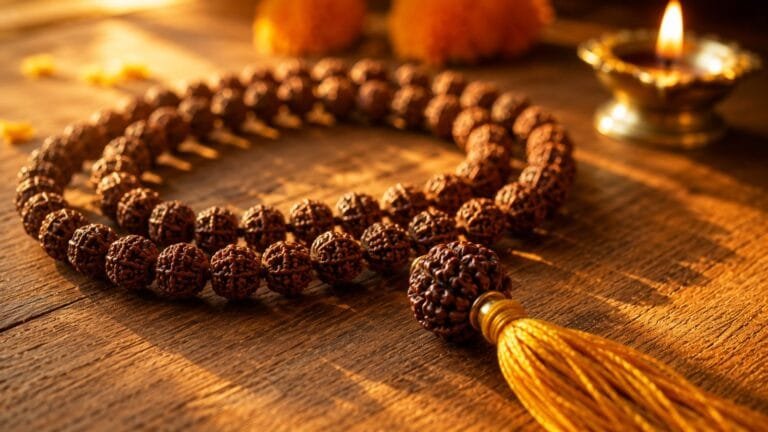
- Rudraksha mala (108 beads): Universally approved for any deity. Swami Sivananda describes rudraksha as suitable for all sadhana. A single mala that works for everyone.
- Sphatik (crystal): Traditionally better suited for Devi sadhana (Lakshmi, Saraswati). Not the ideal match for Hanuman jap.
If you travel often and want one mala for all your jap regardless of deity, rudraksha is the safe, universally appropriate answer.
Which Name to Chant – The Hanuman Mantras
There is a meaningful difference between Hanuman naam jap and reciting the Hanuman Chalisa. Both are valid and beloved practices – but naam jap specifically means the repeated chanting of a name or short mantra with a mala, one repetition per bead. Here are the most common choices for Hanuman naam jap:
- “Jai Shri Hanuman” or “Jai Hanuman”: Simple, direct praise. Easy to sync with the breath, natural for beginners.
- “Om Hanumate Namah”: The eight-syllable mantra. More formal, widely used in puja traditions.
- “Om Sri Ram Jai Ram Jai Jai Ram”: Rama’s own naam, which is traditionally described as Hanuman’s preferred jap. This choice has a beautiful scriptural weight.
That third option deserves a pause. Tulsidas writes in the Ramcharitmanas that Rama’s Name saved more souls than Rama himself – the Name reformed crores of the lost while Rama personally rescued only Ahalya. The verse reads: “राम एक तापस तिय तारी। नाम कोटि खल कुमति सुधारी॥” Chanting Rama’s name through Hanuman’s eyes deepens both connections at once – you honor Hanuman’s devotion by following in it.
How Many Rounds and When
108 repetitions – one full mala – is the standard daily practice for Hanuman naam jap. This maps to the traditional “1 to 10 malas per day” range that Swami Sivananda recommends for all naam jap. One mala takes roughly 10 to 15 minutes, depending on pace.
Two days are especially sacred for Hanuman: Tuesday (Mangalwar) and Saturday (Shaniwar). On these days, 1008 repetitions – about 9 to 10 malas – is a traditional deeper observance. You do not need to do this every day. But making Tuesdays a longer session builds a meaningful weekly anchor into the practice.
Timing follows the same principle as all naam jap: Brahmamuhurta, roughly 4 to 6 am, is best for depth and concentration. Sunrise and sunset are both good secondary windows. For Hanuman, night jap before sleep is also a deeply traditional practice – many devotees count 108 quietly as the last act before sleeping. If keeping an accurate count during busy days is the challenge, a counter like Devta App tracks rounds silently so attention stays on the Name rather than the number.
Two Common Mistakes That Undermine Hanuman Jap
Most mistakes in naam jap are not about the wrong bead – they are about attention and respect for the practice itself.
- Crossing the sumeru bead: The sumeru is the larger bead at the end of a 108-bead mala. Tradition holds that this bead should not be crossed during jap – when you reach it, flip the mala and count back in the direction you came from. This keeps the practice intentional rather than mechanical, and shows respect for the mala as a sacred tool rather than a counting device.
- Rushing the count at the cost of attention: Hanuman jap done at speed but without awareness is like reciting a song only for the tempo record. The power of naam jap comes from the quality of attention in each repetition. A useful anchor: with each “Jai Hanuman,” hold a brief mental image of Hanuman’s form – a fierce yet loving presence. Even 11 repetitions done with full attention carry more than 108 done absently.
Hanuman is known as chiranjeevi – immortal, ever present. He does not require a special hour, a special place, or a perfect bead. He requires sincere repetition of the Name. With the right mala in your hand and the right attention in your heart, one round today is enough to begin.

Can I use a tulsi mala for Hanuman naam jap?
Yes. Tulsi mala is traditionally approved for Hanuman jap. Hanuman belongs to the Vishnu-Vaishnava tradition, and tulsi is Vishnu’s sacred plant. The tulsi prohibition applies only to Shiva jap, not Hanuman.
Which mala bead is best for Hanuman jap?
Both tulsi (108 beads) and rudraksha malas are suitable for Hanuman naam jap. Rudraksha is universally approved for any deity. Sphatik (crystal) mala is traditionally reserved for Lakshmi and Saraswati and is not the ideal choice for Hanuman.
How many times should I chant Hanuman naam jap?
108 repetitions (one mala) daily is the standard. On Tuesdays and Saturdays, which are especially sacred to Hanuman, 1008 repetitions is considered particularly auspicious.
Related Reading