Manas vs Vaikhari Jap: Which One Heals Your Mind?
For centuries, the teachers said: silent mental japa is the most powerful of all. Swami Sivananda placed manasika japa at the top of his four-type hierarchy. Loud chanting – vaikhari – was for beginners, for those whose minds would not stay still without an external sound to hold onto.
In 2025, a research team measured both on 40 participants and found something that maps remarkably onto what the tradition said – but with a nuance worth knowing before you choose your practice.
The 2025 HRV Study: What They Measured
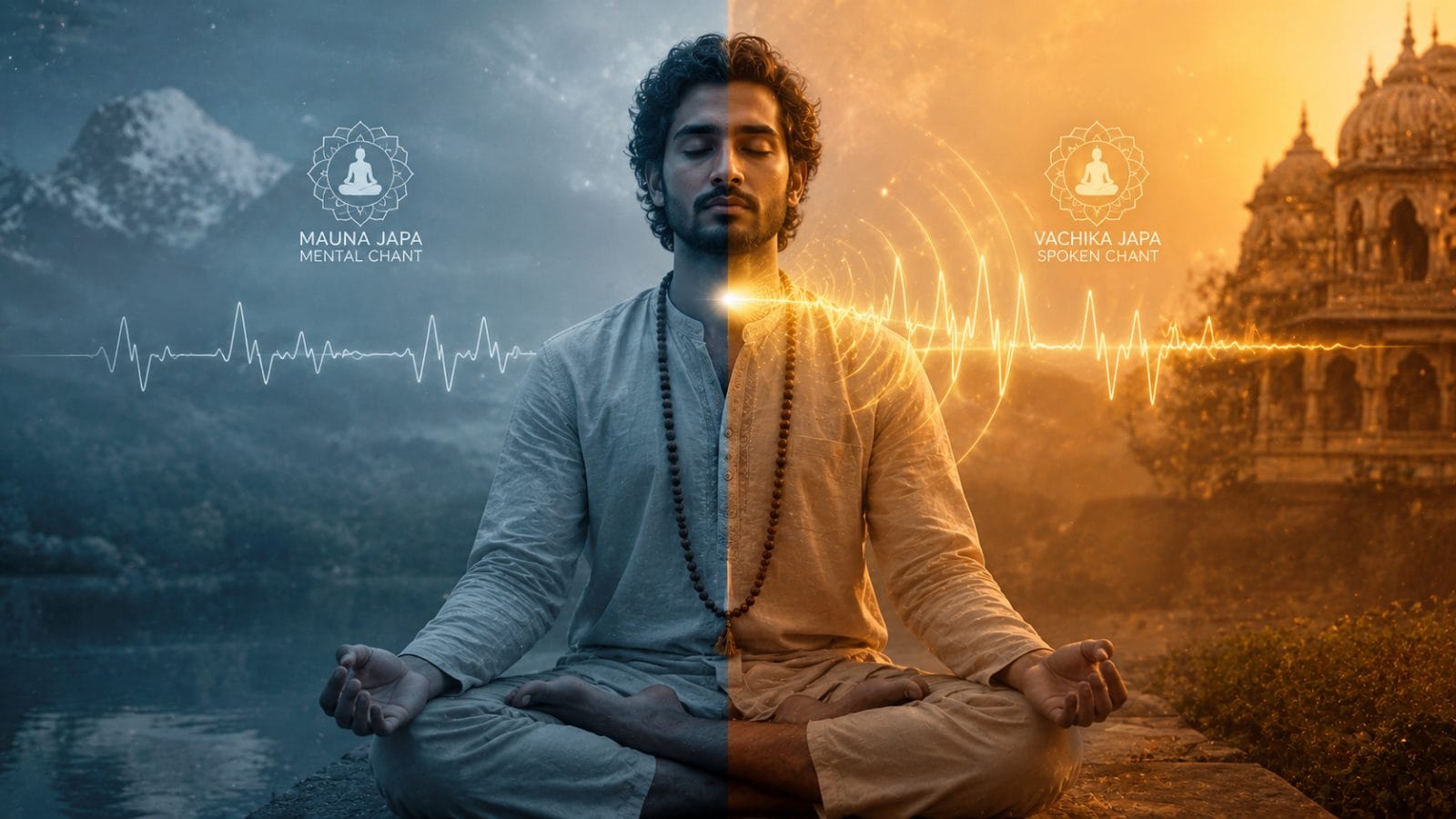
Acharya et al. (2025, PMC12181178, n=40) measured heart rate variability – HRV – during three chanting conditions: loud (vaikhari), lip-only (upamshu), and silent mental (manasika). HRV is a window into the autonomic nervous system: higher parasympathetic (vagal) tone means the body is in rest-and-restore mode; higher sympathetic activity means alert, activated mode.
The findings:
- Silent mental chanting preserved vagal/parasympathetic tone. Heart rate stayed stable. The body remained in a calm, restorative state throughout.
- Loud and lip chanting raised heart rate and sympathetic activity. The body moved into a more activated, energized state.
Important caveat: this is a single small study. Early evidence, not settled science. The researchers framed japa as a complementary mental-health tool – not a medical treatment.
What This Means in Plain Terms
Silent japa calms. Loud japa energizes. Neither is “better” in an absolute sense – they serve different moments:
- Use manasika (silent) when: you want deep rest, you are anxious or overwhelmed, you are practicing at Brahmamuhurta, or you need to chant in public without drawing attention.
- Use vaikhari (loud) when: your mind is very scattered and needs an external anchor, you are chanting with a group or doing kirtan, or you feel spiritually sluggish and need the vibration to sharpen your focus.
- Use upamshu (whisper) when: you want the grounding of physical sound but the setting calls for quiet – shared spaces, transit, a busy workplace.
What the Tradition Says
Sivananda’s four-tier hierarchy (Divine Life Society, dlshq.org):
- Manasika (mental) – most powerful
- Upamshu (whisper, lips only) – more powerful than vaikhari
- Vaikhari (loud) – least subtle, but still powerful; ideal for beginners
- Likhita (written) – engages hand, eye, and mind simultaneously
The logic: the more internal the japa, the deeper the mind turns inward. Loud sound gives the mind something external to grip; mental japa forces it to stand on its own. That is harder – but the result, when achieved, is deeper.
The Common Beginner Mistake
Most people try to start with silent mental japa and find their minds wandering immediately. They conclude “japa doesn’t work for me.” The mistake is skipping the steps. Sivananda’s recommendation: start with vaikhari (loud), move to upamshu (whisper) when the mind steadies, then to manasika when the mind can hold the name on its own. This can take weeks or months. The progression is the practice.
Upamshu: The Underrated Middle Path
Upamshu japa – lips moving, no audible sound – sits between the two extremes and is often the most practical choice for a daily session. It has the grounding quality of vaikhari (lips moving, mouth forming the name) while turning inward like manasika. It is particularly useful in a shared space where you want silence but your mind still needs a physical anchor.
Note: The HRV findings described here are from a single early-stage study and should be understood as preliminary evidence only. Japa practice is a spiritual and wellness tool – it is not a substitute for medical or psychological treatment.
Track Your Practice with Devta App
Whether you chant silently in Brahmamuhurta or aloud in the evening, Devta App counts every repetition with a single tap. Your streak is tracked across days so the daily habit becomes unbreakable. The app works for any deity, any mantra – it is just the counter, so you can focus entirely on the name.

Is manasika japa suitable for complete beginners?
It is the goal for beginners, not the starting point. Start with loud chanting to build concentration, then graduate to silent. Trying to start silent usually leads to a wandering mind and discouragement.
Can I mix silent and loud in the same session?
Yes, and this is actually a traditional approach. Begin with vaikhari to settle the mind, shift to upamshu as attention deepens, and move to manasika once the mind is truly still. Reverse if you start dozing or drifting. The transition points are felt, not timed.
Does the mantra work differently depending on how loud it is?
The tradition says the inner forms are more powerful because they require and develop deeper concentration. The HRV data suggests they also have different physiological signatures. What is certain is that consistent daily practice of any form outperforms occasional practice of the ideal form.
Related Reading