Worship When You’re Sick or Bedridden: Naam Jap Needs Nothing
You are lying in bed. Fever, body ache, exhaustion. You haven’t bathed in two days. Your prayer corner sits untouched across the room. And somewhere beneath the discomfort, a quiet worry surfaces: “Can I even pray like this? Would God accept it from me right now?”
That worry is completely understandable. But every authentic tradition of devotion gives the same answer: yes – and especially now. The Name of God does not require a clean body. It asks only for an honest heart. In fact, many saints have taught that it is precisely in weakness that prayer reaches its deepest.
What Scripture Actually Says: No Purity Rule for Mental Chanting
The Kali-Santarana Upanishad – one of the minor Upanishads of the Atharva Veda tradition – records Brahma’s instruction to Narada on the Hare Krishna maha-mantra. The text is explicit: this name is to be chanted always, whether one is in a pure state or an impure one. There is no exception carved out for illness, hospitals, or not having bathed. The word is always.
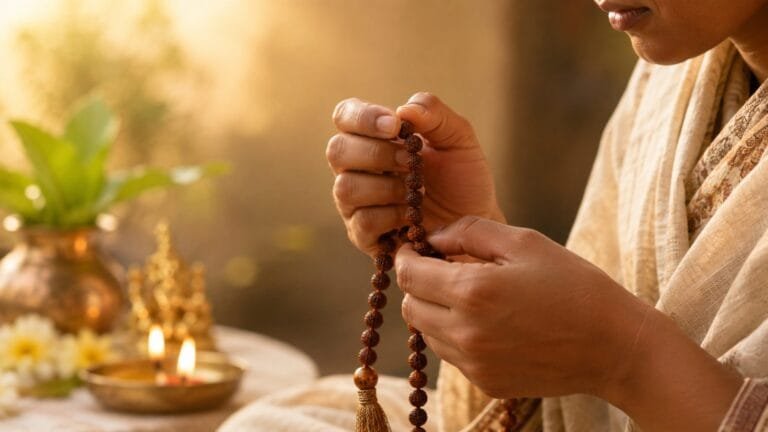
Swami Sivananda of the Divine Life Society, one of the most authoritative modern commentators on japa practice, writes that manasika japa – silent mental chanting, the Name held in the mind without sound or movement – is the most powerful form of all. Not the second most powerful, not a consolation prize for when you can’t sit up straight. The most powerful. And it requires nothing external: no mala, no posture, no cleanliness, no altar.
The Bhagavad Gita (10.25) reinforces this with authority: Krishna says “Among sacrifices I am japa-yajna” – among all forms of sacred offering, the repetition of the Divine Name is Krishna himself. And japa-yajna, unlike fire sacrifices or elaborate rituals, needs nothing but the mind. Illness cannot take away your mind’s ability to hold the Name.
The Distinction Almost Nobody Explains
Here is the nuance that gets lost in most conversations about purity and worship. There are two different things in the tradition: formal ritual worship (puja, havan, temple rites) and naam smaran – the direct remembrance of the Divine Name in the mind and heart. These two practices carry different guidelines.
For formal puja, traditional practice does speak of ritual cleanliness – bathing before touching the idol, ritual purity before havan, and so on. This is the layer of practice that has to do with external form, and it makes sense in that context. But naam smaran – just remembering God, just holding the Name – is not a ritual. It is a relationship. And relationships do not work the same way rituals do.
The error many devotees make – especially when sick – is applying the rules of formal ritual to the act of simply remembering God. “I can’t touch the idol without bathing” becomes “I can’t even say Ram’s name without bathing.” The first statement reflects a traditional custom. The second is not in scripture. And it is the second belief that keeps people cut off from God exactly when they need him most.
5 Ways to Worship When Sick or Bedridden
These five approaches are arranged from simplest to slightly less simple – start where your body is today:
- Silent mental chanting (manasika jap): The highest form. No sound, no movement, no tools. Just the Name in the mind – “Ram… Ram… Ram…” or whichever Name you love. You can do this lying completely flat, with an IV drip in, in a hospital room. Nothing about this requires a healthy body.
- Breath-synchronized chanting: As you breathe in, hold “Ra” in the mind. As you breathe out, “m.” Breath is already happening – so japa happens with it. This is particularly useful in the night hours when sleep won’t come.
- Soft whispering (upamshu jap): If your energy allows, move your lips very slightly and whisper the Name so only you can hear it. This occupies a middle ground between mental and loud chanting, and even in a shared hospital room, it is perfectly quiet.
- Listening to bhajans: When the eyes are closed, when speech is difficult, when all you can do is lie still – listen. Put on a devotional audio and let the Name come in through the ears. Sivananda includes shravan (hearing the Name) as a valid and powerful form of devotion. The Name heard is the Name received.
- Daily darshan on the Devta App: If you have your phone, you can do everything from bed – offer flowers, light a lamp, see your deity’s darshan, and count your jap with a single tap, with no physical contact required. For the sick and bedridden, the Devta App is exactly this: a way to stay connected to your daily devotion without going anywhere or touching anything.
Common Myths That Make Illness Lonelier Than It Has to Be
A few beliefs circulate that add a spiritual burden on top of a physical one. They deserve a direct response.
- “God won’t listen in a hospital room.” Tradition tells us otherwise. The Bhagavata Purana’s account of Ajamila describes a man in his final moments – sick, afraid, in no condition for formal prayer – calling out “Narayana.” That single call, in that state, reached God. No temple, no preparation, no cleanliness. Just a name, spoken from desperation.
- “I need a strong body to pray properly.” Swami Sivananda wrote that manasika japa is more powerful than loud chanting precisely because the mind is engaged without distraction. A weak body that holds the Name quietly may, in truth, be praying more deeply than a strong body going through ritual motions.
- “Illness means God is angry or has abandoned me.” This framing belongs to fear, not to devotion. Illness is part of being human. The saints who chanted through their own sicknesses – and many of them did – did not see illness as divine punishment. They saw it as an invitation to go deeper.
A Note for Caregivers and Family Members
If you are sitting beside someone who is too ill to pray themselves, you can carry the practice for them. Taking a sankalpa – a clear inner intention – and offering your jap for a loved one’s healing and peace is one of the oldest forms of intercessory prayer across all traditions. “May this japa be for [name]’s wellbeing and ease.” One mala a day, held with that intention, is a real and meaningful act.
The Devta App makes this even more practical for families: you can set up a family jap tracker, so that your count goes toward a shared goal for someone you love. Daily darshan for the family – the sick person included, if they can look at the screen for a moment – is also something the app enables without anyone having to go anywhere or prepare anything.
This article is for spiritual and devotional guidance only. Please continue all medical treatment under your doctor’s care. Naam jap is not a substitute for medical treatment – it is a complement to it, one that many people find brings calm, courage, and a sense of connection in difficult times. If you are struggling with your mental health, please reach out to a qualified professional.
The name of God does not check your temperature before it reaches you. It does not ask whether you bathed this morning or whether the room you are lying in is clean enough. It travels to exactly the state you are in right now. The only thing required of you is the smallest movement toward it – one Name, in the mind, from wherever you are.

Can you do naam jap without bathing when you are sick?
Yes, absolutely. The Kali-Santarana Upanishad says to chant always – pure or impure. Mental naam jap (manasika japa) has no purity requirement at all and is also considered the most powerful form of japa by Swami Sivananda.
What is the easiest way to pray when bedridden?
Silent mental chanting (manasika jap) – just holding the Name in your mind. No mala, no sound, no movement required. You can sync it with your breath: inhale with ‘Ram’, exhale with ‘Ram’. The Devta App also enables one-tap jap counting and daily darshan from bed.
Can family members do naam jap on behalf of a sick person?
Yes. You can take a sankalpa (intention) and offer your jap for your loved one’s wellbeing. This is one of the oldest forms of intercessory prayer across traditions. The Devta App lets you track jap for multiple family members too.
Related Reading