Radha Rani Names for Baby Girl: 50 Beautiful Names with Meanings
Radha Rani names for baby girl are among the most auspicious, melodious, and meaning-rich choices in all of Hindu naming tradition. A name drawn from Radha’s own epithets, from her divine companions, or from the Radha-Krishna devotional universe carries with it thousands of years of love, bhakti, and the blessing of Vrindavan itself. This page brings together 50 of the most beautiful, authentic Radha-inspired names for baby girls – with verified Sanskrit meanings, grouped by category, and sourced from classical Vaishnava texts including the Brahma Vaivarta Purana, Garga Samhita, and Rupa Goswami’s Ujjvala Nilamani.
Names of Radha Rani Herself
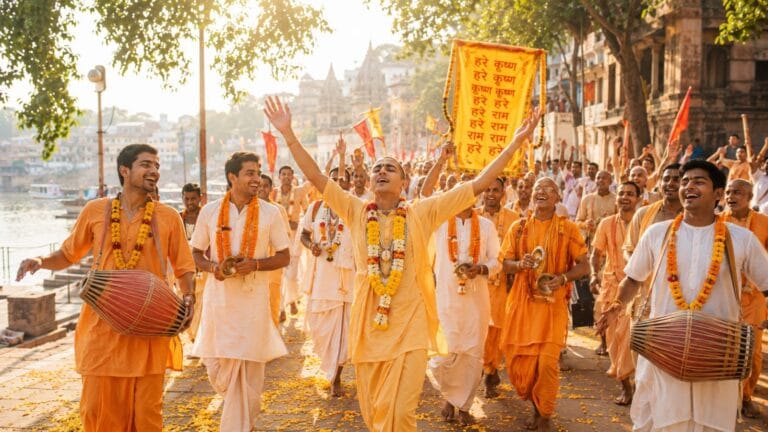
These are direct epithets and names of Shri Radha Rani – found in her traditional namavali (naamavali), stotras, and the 108 names chanted by devotees across Braj, Vrindavan, and Barsana. Each is a name that has been sung in love and prayer for centuries. The root of “Radha” itself is the Sanskrit verb radh – meaning to propitiate, to be fulfilled, to succeed in worship. She is, in the deepest sense, the one in whom devotion finds its completion.
| Name | Sanskrit / Hindi | Meaning |
|---|---|---|
| Radha | राधा | The worshipped one; the beloved who is sought and attained; from Sanskrit radh = to propitiate, to succeed |
| Radhika | राधिका | The dear beloved; the cherished one; affectionate form of Radha meaning “she who is adored” |
| Kishori | किशोरी | Young maiden; adolescent girl – Radha is worshipped in Braj as eternally youthful |
| Vrinda | वृन्दा | A cluster of flowers; the sacred tulsi plant; also the divine presiding deity of Vrindavan forest |
| Madhavi | माधवी | Beloved of Madhava (a name of Krishna); also means “born of spring; intoxicatingly sweet like honey” |
| Haripriya | हरिप्रिया | Beloved of Hari (Krishna / Vishnu); the one most dear to Hari |
| Krishnapriya | कृष्णप्रिया | Beloved of Krishna; the one most cherished by Krishna |
| Govindapriya | गोविन्दप्रिया | Beloved of Govinda; most dear to Govinda (a name of Krishna meaning “the one who gives joy to the cows and earth”) |
| Govindanandini | गोविन्दनन्दिनी | She who brings bliss and delight to Govinda; the source of Govinda’s joy |
| Vrindavaneshvari | वृन्दावनेश्वरी | Queen and mistress of Vrindavan; the sovereign of the forest of Vrinda (tulsi) |
| Padmavati | पद्मावती | She who possesses the lotus; lotus-like in beauty, purity, and grace |
| Chandrika | चन्द्रिका | Moonbeam; moonlight – Radha’s radiant beauty is compared to the full moon’s light |
| Supriya | सुप्रिया | The most beloved; the most dear; extremely cherished |
| Madhura | मधुरा | Sweet; full of sweetness and gentle grace |
| Raaseshvari | रासेश्वरी | Queen of the raas – the divine dance circle; mistress of the sacred raas-lila of Vrindavan |
| Gaurangi | गौरांगी | One with a golden, radiant complexion – from gaura (golden/fair-glowing) and anga (limb/form); Radha’s luminous beauty is celebrated as Gaurangi throughout Braj devotion |
| Shyama | श्यामा | Dark beauty; one with a beautiful, deep-toned complexion – a classical Sanskrit epithet of Radha used in stotras and namavali traditions |
| Srimati | श्रीमती | The exalted, glorious, fortunate one – Srimati is Radha Rani’s most honored title: “Srimati Radharani.” Also a beautiful standalone name for a girl |
A note on one more epithet worth knowing: Vrishabhanu Nandini (वृषभानु नन्दिनी), meaning “daughter of Vrishabhanu” – the king of Barsana and Radha’s father. This is more of a devotional compound address than a standalone given name, but it is deeply beloved in Braj tradition and occasionally used by families with a strong connection to Barsana.
Radha’s Eight Divine Companions – The Ashtasakhis
Radha does not wander Vrindavan alone. She is always surrounded by her eight principal companions – the ashtasakhis – whose love and service to Radha is itself considered a form of the highest devotion. These eight names come from Rupa Goswami’s classical Gaudiya Vaishnava text, the Ujjvala Nilamani (16th century), and from the broader Braj-bhakti tradition. All eight are genuine Sanskrit names that make beautiful, meaningful, and deeply auspicious choices for a baby girl.
| Name | Sanskrit / Hindi | Meaning |
|---|---|---|
| Lalita | ललिता | Playful, graceful, artlessly beautiful; the charmer – she is the chief sakhi, slightly older than Radha, celebrated for sharp wit and fearless devotion |
| Vishakha | विशाखा | She who spreads widely like a branching tree; the wide-spreading one – also the name of a nakshatra (the 16th lunar mansion), considered highly auspicious |
| Chitra | चित्रा | Variegated, pictorial, beautifully formed; picture-perfect – Chitra is celebrated as a gifted artist among the sakhis |
| Indulekha | इन्दुलेखा | Crescent of the moon; moonbeam trace; she who bears the brightness of the moon |
| Champakalata | चम्पकलता | The vine of champak (champaca) blossoms – named after the intensely fragrant golden-white champak flower, beloved in Indian devotion |
| Tungavidya | तुङ्गविद्या | She with lofty, elevated knowledge; master of the arts and music – Tunga = high/exalted, Vidya = knowledge |
| Rangadevi | रङ्गदेवी | Goddess of color, joy, and celebration – Ranga means color, theatrical joy, and the vibrancy of life |
| Sudevi | सुदेवी | Auspicious goddess; the gracious and benevolent divine lady – Su = good / auspicious, Devi = goddess |
Among these eight, Lalita and Vishakha are by far the most popular today as given names. Lalita in particular is used across all Indian communities and carries no complex pronunciation. Vishakha carries an added layer of meaning as it is also a nakshatra – parents who follow Vedic naming traditions will find it doubly significant for daughters born in Vishakha nakshatra (which spans Libra-Scorpio). Chitra and Indulekha are similarly used as girl names across India and have a timeless, classical elegance.
Radha-Inspired Sanskrit Names for Modern Baby Girls
Beyond Radha’s own epithets and her sakhis, the rich universe of Braj devotion – Vrindavan, the sacred tulsi groves, the raas-lila, the language of divine love – gives us a treasury of Sanskrit and Hindi girl names that carry Radha’s spirit. These names are connected to Radha by meaning, by the sacred landscape she inhabits, or by the tradition of devotion that surrounds her. Several of these are popular modern choices that feel contemporary while remaining deeply rooted.
| Name | Sanskrit / Hindi | Meaning |
|---|---|---|
| Radhya | राध्या | Worthy of worship; to be propitiated – a modern Sanskrit-form name from the same root as Radha |
| Priya | प्रिया | Dear, beloved, darling – Radha is addressed as Krishna’s supreme Priya throughout devotional literature |
| Nandini | नन्दिनी | One who brings joy; the joyous one; giver of delight – a name of joy used for beloved daughters across traditions |
| Gopika | गोपिका | A gopi – a devoted cowherd girl of Vrindavan; all the gopis were Radha’s companions and beloved of Krishna |
| Brinda | बृन्दा | A cluster of flowers; sacred tulsi – alternate spelling of Vrinda, widely used across India |
| Madhurima | मधुरिमा | Sweetness; sweet beauty; the quality of being sweetly graceful – Radha’s bhakti is described as the supreme madhurya |
| Manjari | मञ्जरी | A tender flower cluster; a small blossom – in Gaudiya Vaishnava tradition, a manjari is a young devoted attendant of Radha, the ideal of humble service |
| Anuraga | अनुरागा | Devoted love; deep passionate attachment; also “the color red of devotion” – it is the love Radha holds for Krishna |
| Tarangini | तरङ्गिणी | She who flows like waves; one carried by waves of devotion – a poetic Sanskrit name for a girl with a gentle, flowing nature |
| Vraja | व्रजा | Of Vraja (Braj) – the sacred land where Radha dwells; “she who belongs to the holy land of Vraja” |
| Brajrani | ब्रजरानी | Queen of Braj – Radha Rani is worshipped as the sovereign queen of all of Braj |
| Priyatama | प्रियतमा | Most beloved; the dearest one – Radha is addressed as Krishna’s Priyatama in classical devotional poetry |
| Kalyani | कल्याणी | Auspicious; bringer of good fortune and welfare – a time-honored Sanskrit name for a girl who brings blessing and grace |
| Madhuri | मधुरी | Full of sweetness and nectar; the sweet, charming one – from madhura (sweet); one of the most popular girl names across India today and a core quality of Radha’s bhakti |
| Mangala | मंगला | Auspicious; the one who brings auspiciousness and blessings – a traditional Sanskrit name invoking divine grace from the first breath |
Of these, Priya, Nandini, and Brinda are among the most commonly used girl names in India and need no explanation at school or in a professional setting. Manjari is a particularly lovely choice for families rooted in the Gaudiya Vaishnava tradition – it carries a specific, precious meaning as a devoted attendant of Radha. Madhurima and Tarangini have a melodic quality that makes them stand out without being unfamiliar.
Radha-Krishna Devotional Names for Girls
Radha and Krishna are worshipped not just as individuals but as a divine couple – Yugala – whose love represents the union of the soul with the divine. The names in this group emerge from that shared devotional landscape: the raas-lila, the forest bowers of Vrindavan, the divine flute music that Radha can never resist, and the eternal play (leela) of their love. These names honor the Radha-Krishna tradition as a whole.
| Name | Sanskrit / Hindi | Meaning |
|---|---|---|
| Leela | लीला | Divine play; cosmic sport – the eternal raas-leela of Radha-Krishna is the supreme expression of divine love |
| Aaradhya | आराध्या | One who is to be worshipped; adored – from aaradhana (worship); the beloved who is worthy of all devotion |
| Nikunja | निकुञ्जा | Of the sacred forest bower – the kunjas (bowers) of Vrindavan are where Radha and Krishna meet in their eternal lila |
| Vrindavani | वृन्दावनी | She of Vrindavan; one who belongs to the sacred tulsi forest – a poetic form of Vrindavan used in devotional songs |
| Yugala | युगल | The divine pair; the sacred union – Radha-Krishna are worshipped as Yugala, the inseparable divine couple |
| Bansuri | बाँसुरी | The flute – Krishna’s bansuri calls Radha across Vrindavan; a beautiful, lyrical name for a girl |
| Rasika | रसिका | A connoisseur of divine love and beauty; one who fully appreciates the divine rasa – both Radha and Krishna are described as supremely rasika |
| Raasapriya | रासप्रिया | Lover of the divine raas; the beloved of the sacred dance circle – one who delights in Radha-Krishna’s eternal play |
Aaradhya has become one of the most popular girl names in India over the last decade – and for good reason. It is modern-sounding, easy to pronounce, has an unmistakable meaning, and carries the full weight of the devotional tradition. Leela is equally beautiful in its simplicity. Bansuri is an unusual and striking choice – it sounds lyrical when called out loud and carries the whole image of Krishna’s flute song calling Radha home. Rasika is elegant and intellectual, fitting for a family that prizes both bhakti and the arts.
Why Radha Rani’s Names Are Auspicious for a Baby Girl
In Braj and across the Vaishnava world, Radha Rani is not simply one more deity among many. She is worshipped as the embodiment of the highest form of devotion – the bhakti that is so pure, so selfless, and so complete that even Krishna himself considers it the most precious thing in all creation. The Brahma Vaivarta Purana describes Radha as Krishna’s “Hladini Shakti” – the energy through which the divine itself experiences joy. To name your daughter after Radha, or after one of those associated with her, is to invoke that quality of love from the very beginning of her life.
There is also something quietly radical about Radha’s story as a model for a girl’s name. Radha chose devotion not out of obligation but out of the overflow of her own heart. She is not subdued or passive – in the devotional tradition, she is fiercely loving, sovereignly free, and the one whose approval even Krishna seeks. Saints like Premanand Maharaj of Barsana have taught for decades that “Radhe” is not merely a name but a complete prayer – a calling out to the one who is herself the fulfillment of all calling. When you name your daughter after Radha or one of her sakhis, you are placing her under that prayer.
From a practical-devotional standpoint, names rooted in Radha’s tradition also have a beautiful sound quality. Sanskrit vowel-rich names like Radhika, Madhavi, Kishori, Chandrika, and Indulekha roll naturally off the tongue in all Indian languages. They carry a timeless elegance that works equally well in Mathura, Mumbai, or Melbourne.
Choosing the Right Name – Nakshatra, Rashi, and Modern Usability
If your family follows Vedic naming traditions – choosing a name whose starting sound matches the child’s birth nakshatra – here are some useful pointers from the list above. Vishakha (nakshatra 16, Libra-Scorpio) itself is a nakshatra name – daughters born in Vishakha nakshatra are sometimes named Vishakha directly. Names beginning with “Ra” (Radha, Radhika, Rasika, Raasapriya) suit the Ra-sound nakshatras. “Cha” sounds (Chandrika, Champakalata, Chitra) suit the Cha-group. “Ma” sounds (Madhavi, Madhura, Madhurima, Manjari) suit the Ma-group nakshatras. “La” and “Li” (Lalita, Leela) suit Hasta and related groups. However, please confirm your specific nakshatra’s starting syllable with your family jyotishi – the syllables vary slightly across regional traditions.
For modern usability – especially for children growing up in urban India or the diaspora – the best choices from this list are those that are: short enough to avoid constant abbreviation (Radha, Priya, Vrinda, Brinda, Leela, Chitra, Lalita), unambiguously feminine, easy to spell in English, and widely recognized across communities. Radhika ticks every one of these boxes and is probably the single most versatile choice on this entire list. Vrinda, Madhavi, and Kishori are close seconds for a similar reason. Longer names like Champakalata, Tungavidya, or Vrindavaneshvari are genuinely beautiful but tend to get shortened in daily use – families sometimes use the full form for the horoscope and a shorter pet name at home.
One common question: “Is it auspicious to use the exact name Radha or should we use a variant like Radhika?” There is no doctrinal objection in any tradition to naming a daughter simply “Radha” – and many thousands of Indian women carry that name with grace and pride. Variants like Radhika, Radhya, or Radhini simply soften or extend the name while keeping its essence. The choice is entirely one of personal and family preference.
Raise Your Daughter in Radha’s Bhakti – Start from Day One
Choosing a name rooted in Radha’s tradition is one of the first and most lasting gifts a devotional parent can give. But the name is just the beginning. Children who grow up hearing Radhe Radhe in the morning, who see their parents doing daily darshan, who witness the simplicity and joy of a consistent bhakti practice – they absorb that devotion through every sense, long before they can articulate what it means. The name on the birth certificate starts the story; what you build around it gives the name its life.
If you are looking to make your own daily Radha-Krishna bhakti consistent and alive as your daughter grows up watching you, the Devta App offers a simple, beautiful way to do exactly that – daily darshan of Radha Rani and other deities, a jap counter to track your Radhe Radhe or mantra count, and a devotion streak that turns your practice into a gentle, lasting habit. The best devotional inheritance you can give a child is not just her name – it is the sight of her parent, every morning, loving God.

What does the name Radha mean for a baby girl?
Radha comes from the Sanskrit root ‘radh’ – meaning to propitiate, to attain, or to be fulfilled. The name is traditionally interpreted as ‘the worshipped one,’ ‘the accomplished,’ or ‘she who is the fulfillment of pure love.’ In Vaishnava tradition, Radha embodies the highest form of devotion and is considered eternally beloved by Krishna.
Which Radha-inspired names are most popular for baby girls in India today?
The most commonly chosen names are Radha, Radhika, Vrinda, Kishori, Madhavi, Lalita, and Aaradhya – all melodious, widely used, and deeply auspicious. Radhika is especially popular across India for its gentle sound and its meaning of ‘the dear beloved.’ Lalita and Vishakha are also widely loved across generations.
Are the names of Radha’s sakhis suitable as baby girl names?
Yes – the names of Radha’s ashtasakhis such as Lalita, Vishakha, Chitra, and Indulekha are all beautiful Sanskrit girl names with verified meanings, widely used in India today. They carry the same devotional auspiciousness as Radha’s own names, and several – especially Lalita – rank among India’s most beloved girl names.
Related Reading