How Chaitanya Mahaprabhu Took God’s Name to the Streets
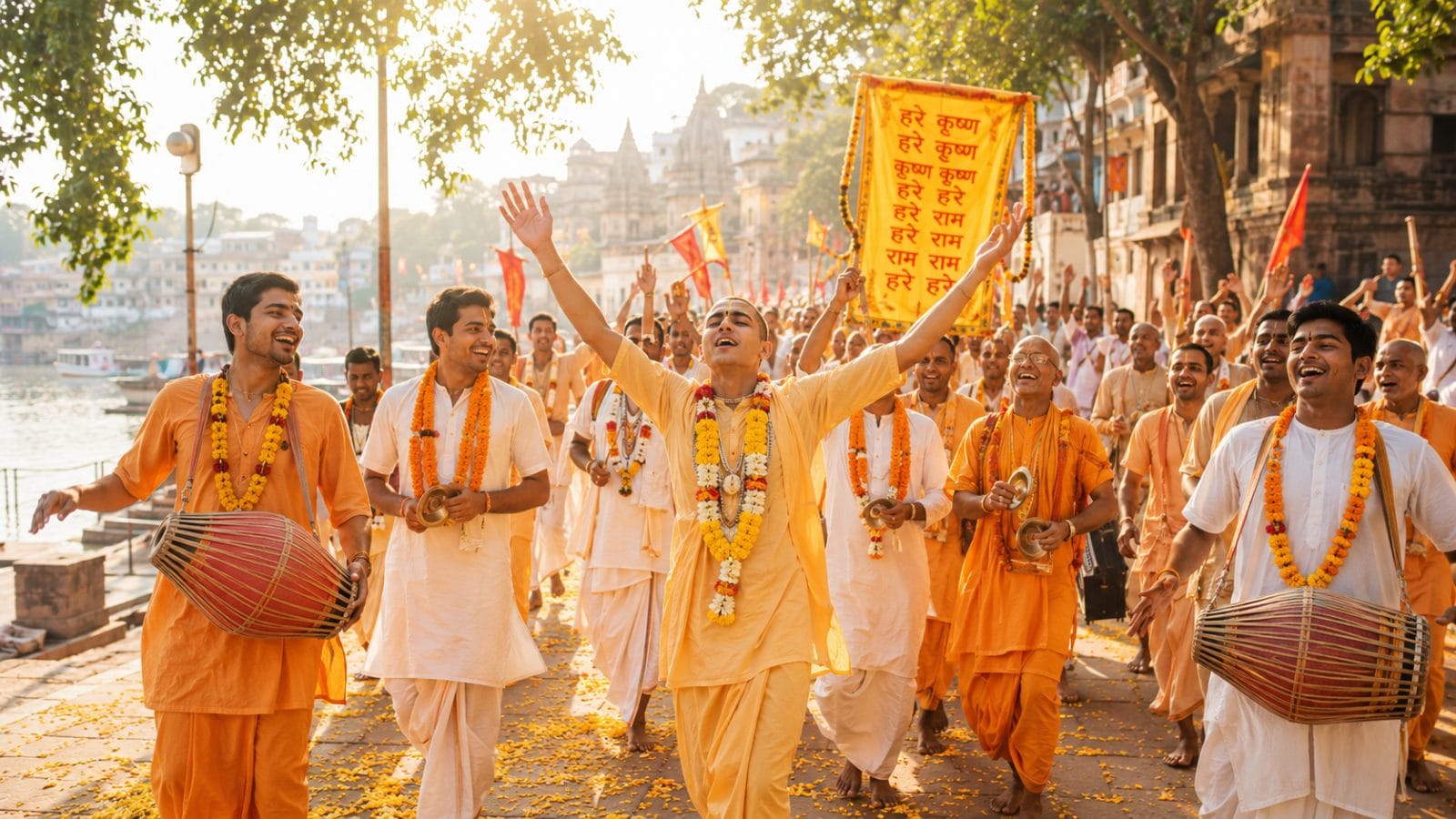
Sometime around 1508, the streets of Navadwip in Bengal witnessed something that had rarely been seen before: a large procession of men from different castes and walks of life moving together through town, singing God’s names at full voice, some weeping with joy, some dancing. Leading them was a young sannyasi who had, just recently, given up a brilliant scholarly career to devote himself entirely to the love of Krishna. His name was Sri Krishna Chaitanya – and what he started that day would ripple forward five centuries and reach every corner of the world.
The practice he revived and transformed is called nagar sankirtan – public communal chanting of God’s names through the streets. Understanding what Chaitanya Mahaprabhu did, and why it mattered, is to understand something essential about naam jap: that the Name was never meant to be confined. It belongs to everyone, in every street, at full voice, with nothing held back.
The World Before Public Sankirtan
In 15th-century Bengal, devotional practice was largely a private affair. Temple worship was regulated by priests and restricted to those deemed ritually pure. The Vedic yajnas and scriptural recitations of the time required knowledge of Sanskrit and adherence to caste rules that excluded vast portions of society. For an ordinary farmer, a woman, an artisan, or anyone outside the twice-born castes, formal religious participation was limited and often dependent on the mediation of a priest.
Group singing of devotional songs existed in various forms – the Bhakti movement had been producing saint-poets for centuries, from Kabir in the north to Tukaram in Maharashtra. But large-scale public processions of chanting that specifically invited everyone, regardless of social standing, were not the norm. Devotion was quieter, more private, and often more conditional.
Into this world, Chaitanya Mahaprabhu arrived with a single, radical premise: God’s Name belongs to everyone. Always. With no qualifications. The Kali-Santarana Upanishad had said as much – that the Hare Krishna maha-mantra could be chanted “pure or impure,” by anyone, at any time. Chaitanya lived this out at scale.
Who Was Chaitanya Mahaprabhu?
Sri Krishna Chaitanya was born on February 18, 1486 CE (Phalguna Purnima) in Navadwip (Nabadwip), a center of Sanskrit learning in Bengal. He was born into a Brahmin family and showed extraordinary intellectual gifts from childhood – by his teens he was running a school and was known for his command of Sanskrit grammar and logic.
The turn came when he was around 22. On a pilgrimage to Gaya, he encountered the Vaishnava saint Isvara Puri and received initiation in the Gopala-mantra. Something shifted permanently. He returned to Navadwip a changed man – no longer interested in scholarly debate but consumed by devotion to Krishna. He began leading nightly sankirtan sessions with a small group of devotees, and the gatherings grew rapidly.
At 24, he took formal sannyasa (renunciation) from Kesava Bharati and adopted the name Sri Krishna Chaitanya. He then walked to Puri, Odisha, to have darshan of Lord Jagannath, where he would spend much of his later life. Gaudiya Vaishnavas hold, by tradition, that Chaitanya was not merely a saint but an avatar of Sri Krishna himself – the Divine descending to taste the love of a devotee from the inside, and to distribute that love freely through the medium of His own Name.
The Nagar Sankirtan – When the Name Went Public
What Chaitanya did with sankirtan was not just to organize group singing. He took it outside. Into the streets of Navadwip, then Puri, and during his famous South India pilgrimage, through town after town. These processions – the nagar sankirtan – were large, joyful, and deliberately public. They included mridangas (clay drums), karatalas (cymbals), and the collective sound of dozens or hundreds of voices together.
The mantra at the center of it all was the 16-name Hare Krishna maha-mantra: Hare Krishna Hare Krishna Krishna Krishna Hare Hare / Hare Rama Hare Rama Rama Rama Hare Hare. Chaitanya taught this mantra as the specifically appointed practice for the Kali Yuga – the one that requires nothing of the chanter except sincerity. In Vrindavan, he is described as having led sankirtan processions that brought tears to even the most hard-hearted onlookers.
The close associate Nityananda Prabhu extended the work even further, going into the most marginalized communities and insisting that the Name was for them too. The stories of Jagai and Madhai – two notorious men from Navadwip who were reformed not by punishment but by being given the Name – became emblematic of the movement’s central claim: no one is too far gone for the Name to reach.
The Radical Equality of Naam – Why This Changed Everything
The social implication of Chaitanya’s sankirtan was quietly enormous. In a society stratified by caste and ritual purity, here was a practice where a Brahmin scholar stood beside a fisherman and both chanted the same Name with the same access to the same grace. The Name did not ask for your caste certificate before working. It did not require you to speak Sanskrit. It only asked you to open your mouth, or your mind, and remember.
Chaitanya drew this directly from the Bhagavata Purana and the Gita’s own testimony. Bhagavad Gita 10.25 – “among sacrifices, I am japa-yajna” – had already established japa as the simplest and most rule-free of all sacred acts. Chaitanya turned this philosophical statement into a lived social reality. Naam sankirtan was not theology; it was a practice anyone could join, right now, in the street.
His biographies – the Chaitanya Charitamrita by Krishnadasa Kaviraja and the Chaitanya Bhagavata by Vrindavana Dasa Thakura – document hundreds of accounts of people whose lives were changed by a single encounter with sankirtan. What united them was not background or knowledge but the experience of the Name.
The Living Legacy – From Navadwip to the World
After Chaitanya’s passing in 1534, his work was systematized by the Six Goswamis of Vrindavan – Rupa, Sanatana, Raghunatha Dasa, Raghunatha Bhatta, Gopala Bhatta, and Jiva Goswami – who wrote the theological and devotional literature that grounded the Gaudiya Vaishnava tradition. For the next four centuries, the tradition was kept alive through sampradaya (lineage) in Bengal, Vrindavan, and Puri.
The global spread came in 1966, when A.C. Bhaktivedanta Swami Prabhupada founded the International Society for Krishna Consciousness (ISKCON) in New York City. He brought to the West exactly what Chaitanya had practiced in Navadwip: public naam sankirtan, the Hare Krishna maha-mantra, and the insistence that the Name was for everyone. The famous photographs of Prabhupada leading kirtan in Tompkins Square Park in 1966 are the modern echo of processions through Bengal five centuries before.
Today, ISKCON’s annual World Holy Name Week (an outgrowth of the Harinama Sankirtan Week begun in 1996) celebrates this unbroken tradition of public chanting. Thousands of devotees in cities across India, Europe, America, and South America take the Name to the streets – exactly as Chaitanya did in Navadwip.
And at the personal level: every time you sit with your mala or tap a jap counter and repeat the Name – even in silence, even alone – you are participating in the same movement. Chaitanya’s gift was not a new theology. It was permission: the Name is yours. Start now. The way to honor his legacy is not to study it but to practice it. Your daily naam jap is a continuation of those first processions down the riverbank streets of Bengal, one repetition at a time.
If you want to build that daily practice – whether it is the Hare Krishna maha-mantra, Ram naam, or any name that resonates – Devta App offers a simple jap counter to track your rounds, daily darshan of your chosen deity, and free devotional reels to keep the bhav alive. The Name has never been easier to reach.
The Name does not belong to temples or scholars. It belongs to whoever opens their mouth – or their mind – and remembers.

Who was Chaitanya Mahaprabhu?
Chaitanya Mahaprabhu (1486-1534 CE) was a saint-philosopher born in Navadwip, Bengal. He is the founder of the Gaudiya Vaishnava school and is credited with bringing public naam sankirtan – communal chanting of God’s names in procession through towns – to a mass audience, regardless of caste or background. Gaudiya Vaishnavas consider him an avatar of Sri Krishna.
What is nagar sankirtan and what did Chaitanya change?
Nagar sankirtan means a public procession of devotees singing God’s names through town streets. Before Chaitanya’s movement, group chanting was largely confined to temples or private homes. Chaitanya led large, joyful processions through Navadwip and later Puri, welcoming people of all castes – a radical opening of devotional practice that had been largely restricted by social hierarchy.
How does Chaitanya’s legacy connect to naam jap today?
His tradition was documented by the Six Goswamis of Vrindavan and later carried forward by Srila Prabhupada, who founded ISKCON in 1966 and brought the Hare Krishna maha-mantra to the West. Today, millions around the world chant the same 16-name mantra Chaitanya championed – a direct continuation of a movement that began on the riverbanks of 15th-century Bengal.
Related Reading