Which Mantra for Which God? The Complete Naam Jap Guide
Most people searching “which mantra should I chant” end up with a list of options and no clear way to choose between them. Or they inherit their family’s mantra and never learn the reason behind it – which can leave years of sincere practice tinged with a quiet doubt: am I chanting the right one?
Hindu tradition has a clear answer. Every major deity comes with a principal naam – their own name-mantra – paired with a specific bead and, in some cases, a specific time to chant. This pairing is not ceremonial. It reflects the nature of each deity and the internal logic of each practice. This guide puts the whole picture in one place.
Why Each Deity Has Their Own Naam
The word “namah” in any mantra – Namah Shivaya, Namo Narayanaya – literally means “I bow, I surrender to this.” You are surrendering specifically to the quality of the divine that deity embodies: Shiva’s transforming grace, Vishnu’s sustaining presence, Lakshmi’s radiant abundance. The specificity is not arbitrary – it is the point.
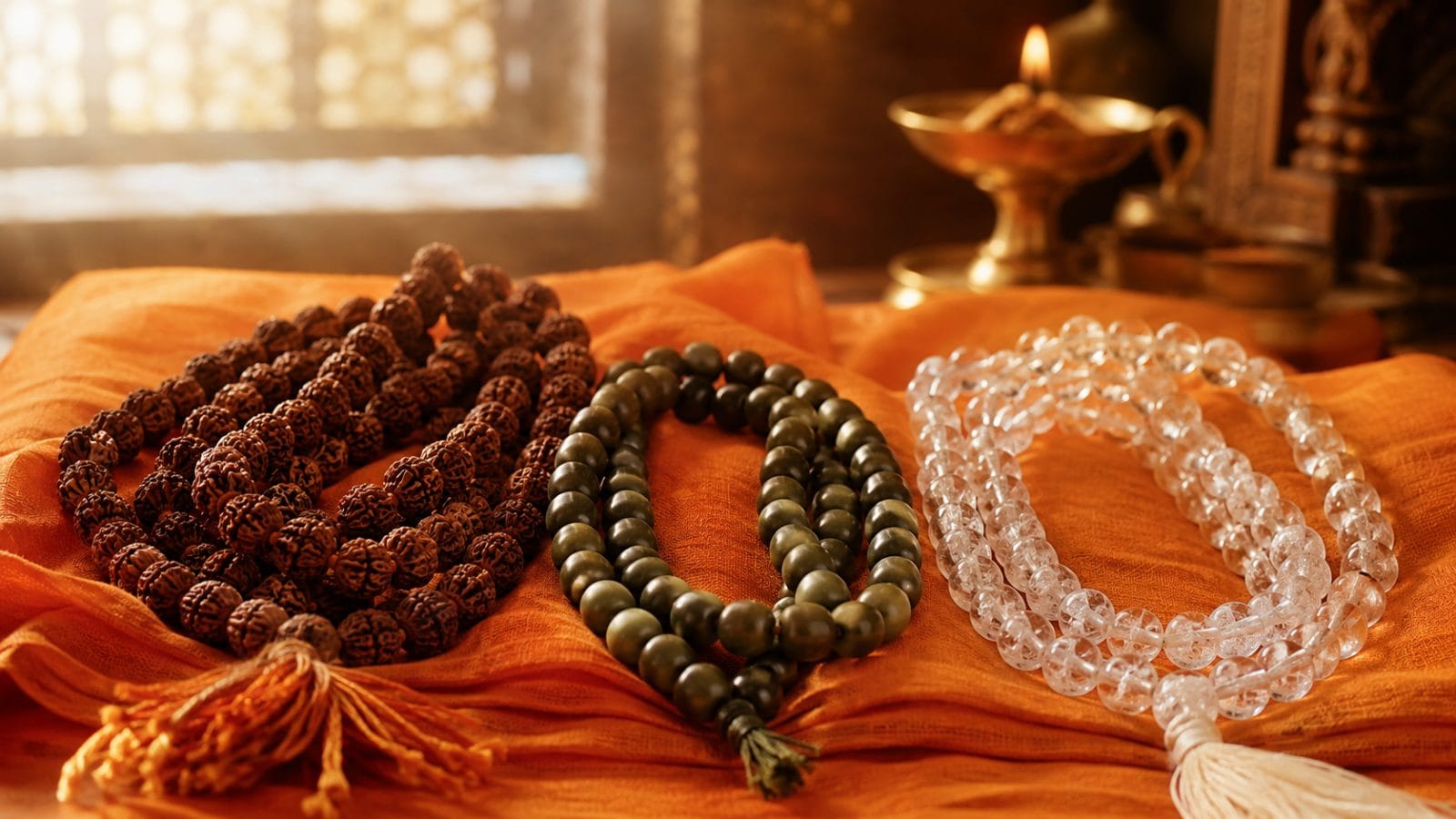
In the Bhagavad Gita (10.25), Krishna himself says: “Yajnanam japa-yajno ‘smi” – among all sacrifices, I am japa-yajna. Mukundananda and other teachers note that japa is the simplest of all yajnas – no fire, no priest, no fixed location required. But the deepest japa, every school agrees, is the japa of your ishta devata’s naam – your chosen deity’s own name.
The mala adds a third layer. Tulsi is Vishnu’s sacred plant – “Vishnupriya.” Rudraksha fell from Shiva’s tears, says the Shiva Purana. Sphatik (crystal quartz) carries the luminous purity associated with Lakshmi and Saraswati. The mala is not decorative – it aligns the physical practice with the deity’s world. Match all three – naam, mala, and time – and your japa becomes a unified act instead of a borrowed routine.
Shiva – Om Namah Shivaya and the Rudraksha Bond
Om Namah Shivaya is one of the most chanted mantras in Hindu practice. Its five core syllables – Na Ma Shi Va Ya – give it the name Panchakshara, the five-syllable mantra. Each syllable corresponds to one of the five elements: earth, water, fire, air, space. The Shiva Purana holds that these syllables are Shiva’s own body – to chant them is to invoke his cosmic form through his Name.
The paired mala is rudraksha. “Rudraksha” comes from “Rudra” (Shiva) and “aksha” (eye) – literally “Shiva’s eye.” The Shiva Purana recounts that rudraksha beads fell from Shiva’s tears during deep meditation. Whether held as sacred lore or a literal account, the pairing is ancient and consistent across every Shaiva school.
One rule is firm: tulsi mala is traditionally not used for Shiva mantras. Tulsi belongs to the Vaishnava world – Vishnu’s plant, carrying Vishnu’s sacred association. Using it for Shiva jap creates a theological mismatch that most traditional teachers point out. Rudraksha, by contrast, is universally accepted for any deity’s naam – making it the safest single mala if you practice across traditions.
Best times for Shiva jap: Brahmamuhurta (the pre-dawn hour), Pradosh (dusk on the 13th lunar day each fortnight), Mondays, and Mahashivaratri. The three sandhyas – junctions of morning, noon, and evening – are also particularly auspicious for any naam jap, including Shiva’s.
The Vaishnava World – Vishnu, Rama, Krishna, and Hanuman
The Vaishnava tradition shares one mala – tulsi – and carries some of the most striking scriptural authority for naam jap in the entire Hindu canon.
Vishnu and Narayana – Om Namo Narayanaya
Om Namo Narayanaya is the Ashtakshara – the eight-syllable mantra of Vishnu, sourced in the Taittiriya Aranyaka (a section of the Yajurveda), making it one of the oldest recorded Vaishnava mantras. “Narayana” means “the refuge of all beings” – from “nara” (all beings, or the primordial waters) and “ayana” (refuge, abode). In the Narayana Upanishad, he is described as the ground from which both Brahma and Shiva arise. Tulsi mala is its natural companion.
Rama – Om Sri Ram Jaya Ram
For Rama, the principal naam is Om Sri Ram Jaya Ram Jaya Jaya Ram. But Tulsidas – the 16th-century saint whose Ramcharitmanas is the most widely read devotional text in North India – made a claim that goes beyond any mantra chart. He wrote that the Naam of Rama exceeds Rama himself in its reach: “Rama ek tapas tiya taari, Naam koti khal kumati sudhaari” – Rama personally liberated one woman (Ahalya), but the Name “Ram” has reformed crores of sinners.
He went further still: “Mahamantra joi japat Mahesoo, Kashi mukti hetu updesoo” – the great mantra that Shiva himself whispers at Kashi to grant liberation to the dying is Ram Naam. The god of the Shaiva tradition, chanting a Vaishnava name at the moment of death – this verse is one of the most striking in all of Tulsidas. The Naam, he says, crosses every tradition.
Krishna – Hare Krishna Maha-Mantra
The Hare Krishna maha-mantra – Hare Krishna Hare Krishna Krishna Krishna Hare Hare, Hare Rama Hare Rama Rama Rama Hare Hare – is described in the Kali-Santarana Upanishad as the mantra given by Brahma to Narada specifically for the age of Kali. Its defining feature: the Upanishad explicitly says it requires no purity, no initiation, and may be chanted “always, pure or impure.” This is the zero-barrier entry of the Vaishnava tradition.
A 2024 EEG study (Mohanty et al., published in Elsevier) measured brainwave activity before and after exactly 108 repetitions of this maha-mantra and found a significant rise in alpha brainwave power – associated with relaxed, focused alertness. This is early evidence from one study, not a proven medical benefit. The researchers framed it as a complementary approach to mental well-being. (Mantra practice is a spiritual and devotional discipline – not a substitute for medical treatment.)
Hanuman – the Tulsi Surprise
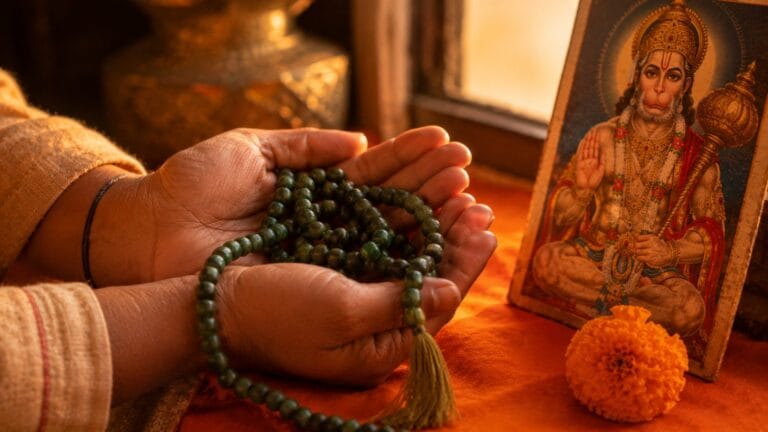
People expect Hanuman to have his own mala exception. He does not – tulsi works for Hanuman jap, which surprises many who know Shiva cannot use tulsi. Hanuman’s entire spiritual identity is as Rama’s devotee; he belongs to the Vaishnava world in every sense. The Vaishnava mala follows him there. Tulsi for Hanuman jap is traditional and correct.
Shakta Tradition – Devi, Lakshmi, Saraswati, and Durga
The Shakta tradition’s most important mala rule is the reverse of what most people assume: tulsi is not used for Devi mantras. Tulsi (Vrinda Devi) is woven entirely into the Vaishnava story – she is Vishnu’s beloved, not of the Shakti lineage. Using the Vaishnava mala for Shakti worship creates a mismatch most traditional teachers note.
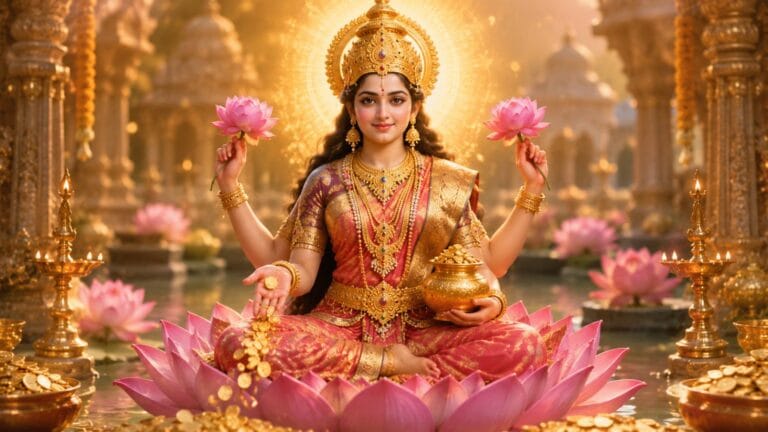
For Lakshmi and Saraswati, the traditional mala is sphatik – clear crystal quartz. Sphatik’s luminous, translucent purity maps onto the nature of both goddesses: Lakshmi’s radiant abundance and Saraswati’s light of knowledge. Their traditional mantras:
- Lakshmi: Om Shreem Mahalakshmiyai Namah – on sphatik mala, 108 repetitions. Fridays and Brahmamuhurta are particularly auspicious.
- Saraswati: Om Aim Saraswatyai Namah – on sphatik mala. Basant Panchami is Saraswati’s primary jap season, though the daily practice is year-round.
There is a traditional belief that sphatik mala used consistently in Lakshmi worship draws the practitioner toward abundance over time – not as an instant result, but as the natural fruit of sincere devotion to the goddess of wealth. This is a devotional belief rooted in centuries of practice.
For Durga, rudraksha or sphatik are both appropriate – tulsi does not apply here either. The Navarna mantra (Om Aim Hreem Kleem Chamundayei Viche) and various Devi beej mantras are used. Tuesdays, Ashtamis, and Navratri are the primary seasons – though Durga’s naam is chanted year-round by her devotees.
If you practice multiple deity malas and tracking each deity’s count separately becomes a distraction, a jap counter like Devta App handles the tally across practices. Your attention stays on the Name; the app keeps the streak alive and the count accurate for each session.
Gayatri – The Mantra That Times Itself
Gayatri is in its own category. Addressed to Savitur – the solar principle – it is one of the oldest mantras in the Vedic tradition, appearing in the Rigveda (3.62.10). And unlike most mantras, it comes with a built-in timing structure: tradition prescribes it at the three sandhyas – sunrise, midday, and sunset.
The word “sandhya” means juncture. These three daily transitions are considered moments when spiritual energy is most concentrated. Of the three, Brahmamuhurta – the pre-dawn period ending at sunrise – is considered most potent for japa generally, and the most auspicious for the morning Gayatri. 108 repetitions per sandhya is the standard count. Rudraksha or sphatik mala are both conventional for Gayatri jap.
The Three Most Common Mistakes
Using tulsi for Shiva or Devi. This is the most frequent mala mismatch. Tulsi belongs to the Vaishnava world. For Shiva mantras or any Devi mantra, use rudraksha or sphatik. Tradition says God sees the bhava (feeling) first – but matching the mala aligns every element of your practice in the same direction.
Picking the “most powerful” mantra instead of your deity’s naam. People sometimes read that the Hare Krishna maha-mantra is the Kali Yuga remedy and drop their own chosen deity’s naam entirely. The two are not in conflict. The maha-mantra is an open entry point; once you have an ishta devata, their naam goes deeper into your specific devotional relationship.
Counting over quality. A 2025 HRV study (Acharya et al., n=40) found that silent chanting preserved parasympathetic (calming) tone better than loud chanting, which raised heart rate and sympathetic activity. This maps directly onto Swami Sivananda’s classical teaching: manasika japa – mental chanting – is the most powerful form of naam jap. A hundred focused reps outperforms a thousand mechanical ones.
Where to Start If You’re New
Pick one deity. Learn their naam. Get their mala. Chant 108 times at the same hour each day for 21 days. That is the entire starting method. The Bhagavad Gita calls japa-yajna the simplest sacrifice precisely because it needs nothing external – no fire, no priest, no ritual space.
If you have no strong deity connection yet, start with the Hare Krishna maha-mantra. The Kali-Santarana Upanishad designed it for maximum accessibility – no background, no purity requirement, no initiation. It is the explicit zero-barrier entry point into naam jap for the current age.
And if the counting itself becomes a distraction – if moving mala beads splits your focus – a dedicated jap counter like Devta App handles the number silently while you give your full attention to the Name. It works for any deity’s naam, tracks your streak day by day, and keeps the daily habit intact.
Every naam in this guide has been chanted by millions of devotees across centuries. The question was never which one is best – it was which one is yours.
Can I use a rudraksha mala for all deity mantras?
Yes – rudraksha is universally accepted across Hindu traditions. The key restriction: tulsi mala works well for Vishnu, Ram, Krishna, and Hanuman, but is traditionally not used for Shiva or any Devi mantra.
Which mantra and mala should I use for Lakshmi?
Traditionally, Om Shreem Mahalakshmiyai Namah is Lakshmi’s naam, and a sphatik (crystal quartz) mala is considered most suitable – along with Saraswati worship. Tulsi mala is not conventional for Lakshmi jap.
Is there one mantra that works if I don’t know which deity to choose?
The Hare Krishna maha-mantra, from the Kali-Santarana Upanishad, is described as requiring no rules, no purity conditions, and no initiation – making it the most accessible starting point for anyone, in any state.
Related Reading