Japa vs Dhyana vs Kirtan: Which Sadhana Is Right for You?
Every spiritual guide says “just meditate.” But millions of practitioners find that sitting still and forcing the mind into silence is the fastest route to frustration – or sleep. There is a reason japa, dhyana, and kirtan have coexisted for centuries across every strand of Hindu tradition: they suit different minds, different temperaments, and different moments in life.
These three are not competing methods. They are different doors into the same house. Understanding what each one actually does – and who it is built for – is one of the most practically useful things a sadhaka can know.
A Quick Map: What Each Sadhana Actually Is
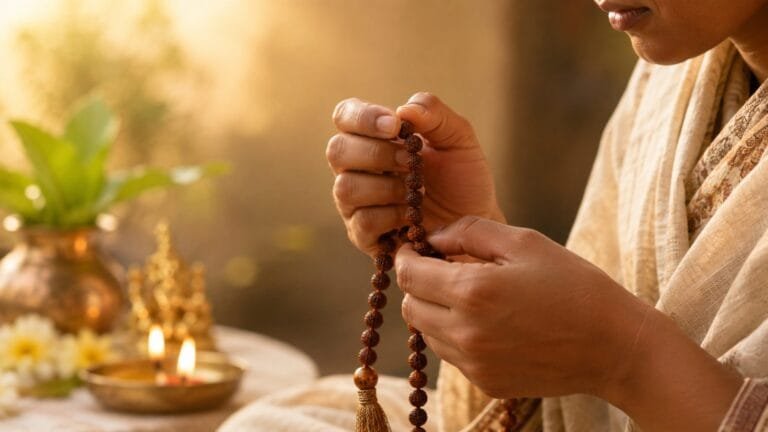
Japa is the repetition of a divine Name or mantra – silently, in a whisper, aloud, or in writing. The mind has a specific object to hold. It can be done alone, in any position, in any state of purity, at any hour. The Kali-Santarana Upanishad, one of the earliest textual sources for the Hare Krishna maha-mantra, says to chant “always, whether pure or impure” – no rules, no barrier to entry.
Dhyana is sustained inward awareness – what the West loosely calls “meditation.” In Patanjali’s Ashtanga Yoga it is the seventh limb, following dharana (concentration). The mind is not given a verbal object to repeat; instead, it rests in an open, expansive state. Dhyana typically emerges from a foundation of concentration practice – you cannot simply decide to “do dhyana” without some prior steadying of attention.
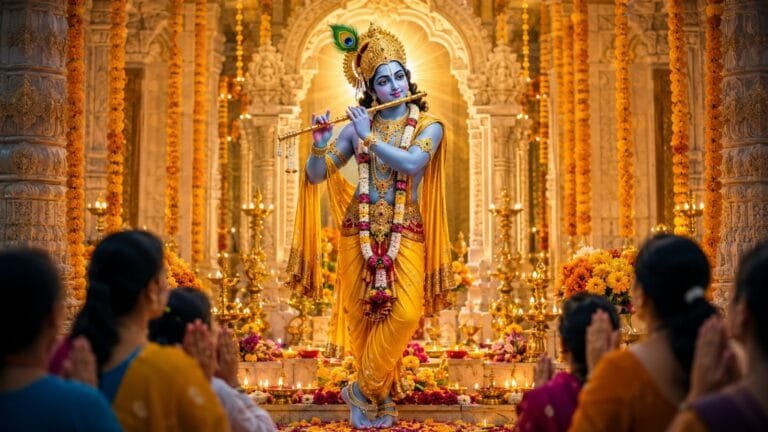
Kirtan is communal or solo singing of divine Names – call-and-response, bhajan, or sankirtan. It is physical, vocal, often rhythmic. The 16th-century Chaitanya Mahaprabhu made sankirtan – congregational chanting of the Hare Krishna maha-mantra – the defining bhakti practice of his tradition precisely because it required nothing: no learning, no ritual preparation, no sitting still. Anyone could join.
Japa – For the Mind That Needs an Anchor
In the Bhagavad Gita (10.25), Krishna says: yajnanam japa-yajno ‘smi – “among all sacrifices, I am japa-yajna.” Swami Sivananda, drawing on this and Manusmriti 2.85 (which traditionally ranks japa among the highest forms of spiritual practice), called japa the simplest yajna – requiring nothing external, generating no gap between the practitioner and the divine Name.
Japa works precisely because it gives the restless mind something to hold. The analytical mind, the worried mind, the mind that cannot “let go” – all of these can grip a Name. That is the design. Unlike dhyana, which asks the mind to release its grasp on objects, japa gives it one perfect, sacred object to hold instead. The mind does what it does naturally – it repeats – and that repetition becomes the practice.
A 2024 EEG study (Mohanty et al., Elsevier) found that chanting the Hare Krishna maha-mantra for exactly 108 repetitions raised alpha brainwave relative power from 24.56% to 32.94% – suggesting a measurable shift toward calm, restful alertness. This is early evidence from a small study – not a clinical claim – but it points in the same direction the tradition has always pointed: consistent japa settles the mind. A 2025 HRV study (Acharya et al., n=40) added a useful nuance: silent chanting preserved parasympathetic (calming) tone, while loud chanting drove sympathetic (energizing) activity – mapping directly onto Swami Sivananda’s teaching that manasika (mental, silent) japa is the most powerful form.
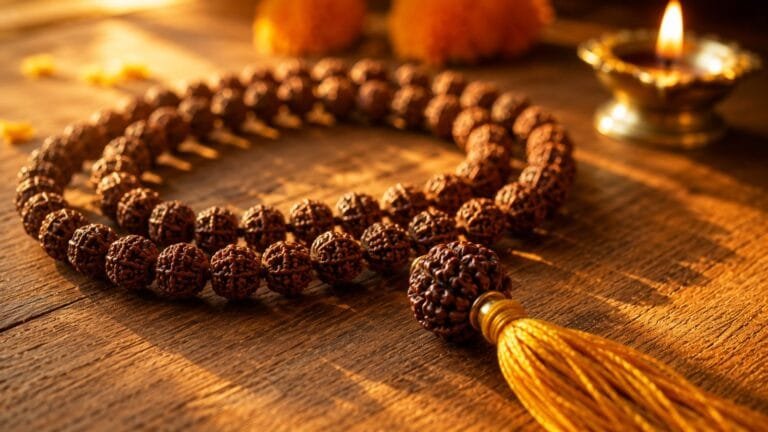
Japa is also the most portable sadhana. Commuting, cooking, waiting, walking – if keeping count is the hard part, a jap counter like Devta App does it for you so your attention stays on the Name, not the number. The count travels with you without the need to carry a mala.
Dhyana – For the Mind That Has Already Steadied
Dhyana is not the starting point – it is closer to the destination. In Patanjali’s system, it follows dharana (holding attention on one point) and precedes samadhi (total absorption). Most contemporary “meditation” instructions blend dharana and dhyana without distinguishing them, which is why beginners often feel they are “failing at meditation” when they are simply doing dharana – which is normal and necessary, not a failure.
The practical relationship between japa and dhyana is one of preparation and arrival. When a practitioner has done enough japa that the Name comes easily and the mind is less reactive, dhyana emerges more naturally. Many teachers describe this progression: japa deepens into manasika (mental) jap, manasika deepens into ajapa (effortless repetition with the breath), and from ajapa, the open expansive awareness of dhyana opens on its own.
The limitation of dhyana as a starting practice is that it demands something most beginners have not yet built: a sufficiently steady, non-reactive mind. Asking an untrained mind to “observe without labeling” or “rest in pure awareness” is like asking someone to run before they can walk. It can be done, but the injury rate is high – in the form of frustration, distraction-spirals, or simply giving up. This is not a criticism of dhyana; it is a note about sequencing.
Kirtan – For the Heart That Needs to Open
Kirtan does something japa and dhyana often cannot: it bypasses the analytical mind entirely and works through the body, breath, and voice. The rhythm, melody, and communal energy create a kind of resonance that is difficult to access in silent sitting. This is why kirtan is so consistently described as “opening the heart” across traditions – it reaches the devotional channel directly, without requiring the mind to first cooperate.
ISKCON’s World Holy Name Week – established in 1996 and expanded to a full week in 2008 – centers on japa marathons and sankirtan. The tradition’s logic is that the Name sung aloud in community has a particular quality: it is not only the practitioner who benefits, but everyone in earshot. This is why Chaitanya Mahaprabhu emphasized sankirtan even over private japa: it spreads the Name beyond the individual.
The limitation of kirtan is practical: it requires your voice, some energy, and ideally a group or at least a quiet space where singing is possible. The same HRV study that found silent chanting calming found loud chanting to be energizing – which is exactly right for a morning session, but not ideal before sleep. For winding down, silent manasika japa is more appropriate.
Three Common Misconceptions Worth Clearing Up
- “Kirtan is just devotional music, not real sadhana”: Chaitanya Mahaprabhu – one of the most influential bhakti saints in Indian history – taught that namakirtan is the single most powerful practice for this age. It is as serious a sadhana as any sitting practice.
- “Silent japa does not really work – you have to chant out loud to get the benefit”: Swami Sivananda explicitly called manasika (mental, silent) japa the most powerful form. The HRV data supports this for calming effects. Loud chanting is powerful in its own way, but not superior to silent japa.
- “Dhyana is always deeper than japa”: For a practitioner whose mind is still restless, dhyana attempted prematurely produces nothing but distraction. Japa in that state is far more effective. The hierarchy exists, but the steps must be taken in order.
How to Choose – A Practical Framework
The honest answer is: start with what you are drawn to, then let the practice guide you. But if you want a clearer framework:
- If your mind is restless and analytical: Start with japa. Give it something to hold. 108 repetitions, one Name, daily. The counting gives structure; the Name gives direction.
- If you feel emotionally blocked or disconnected from devotion: Kirtan first. Attend a bhajan session, or sing alone at home. Let the voice and rhythm do what the sitting mind cannot.
- If you already have a consistent daily japa practice: Begin extending sessions with 5-10 minutes of silent sitting after japa finishes. Watch what happens when the Name settles. That is dhyana beginning to emerge on its own.
- A complete daily sequence (30-40 min total): 5-10 minutes of soft kirtan or bhajan to open the session, 20 minutes of manasika japa, 5-10 minutes of silent sitting afterward. This follows how the mind naturally softens – from sound, to subtle sound, to silence.
No sadhana is universally superior. But for someone standing at the beginning, japa has the lowest barrier: private, portable, ruleless, measurable. Every mala completed is a finished offering.
Dhyana is where you arrive. Kirtan is the fire that warms you up. Japa is the road you walk every day.
Can I practice all three – japa, dhyana, and kirtan?
Absolutely. Many practitioners combine them: kirtan opens the heart, japa deepens focus, and dhyana follows naturally as the mind settles. They reinforce rather than replace each other.
Which is best for absolute beginners?
Japa (naam jap) is widely considered the most accessible sadhana for beginners, because it gives the restless mind something concrete to hold. Swami Sivananda called japa the simplest yajna – rule-free, doable anywhere, anytime.
Does japa count as meditation?
Japa is a form of devotional concentration that overlaps with meditation but is distinct: japa uses the Name as the object of focus, while dhyana aims at sustained, expansive awareness beyond any fixed object. Both calm the mind, but through different mechanisms.
Related Reading