Where Your Attention Goes When You Count
Here is something that most guides on mantra chanting do not say directly: counting is a means, not the goal. The goal is the Name. Counting exists to keep you honest about how much time you have actually given to the practice – and to remove the mental effort of tracking so you can give all your attention to the Name itself. When counting works well, you barely notice it. When it works badly, the count becomes the entire practice, and the Name is the distraction.
The difference between a practice session where the Name fills your mind and one where you are anxiously watching a number is almost entirely determined by how you count – not by the mantra you chose or how many times you said it.
Why Counting Matters at All
Swami Sivananda of the Divine Life Society wrote that japa’s power comes from regularity, and regularity requires a measure. A daily count target – even a modest one like one mala (108 repetitions) – creates a beginning and an end to each session. Without it, practice sessions expand and contract unpredictably, tend to end early on difficult days, and accumulate no sense of forward movement over time.
Traditional teachers from different lineages converge on the 108-count unit. The number has a practical dimension: 108 repetitions of most mantras takes between 5 and 15 minutes at a comfortable pace. That is long enough to matter, short enough to fit into a morning without a major schedule reorganization. The EEG study by Mohanty et al. (2024, Elsevier) that measured alpha brainwave changes during Hare Krishna mahamantra chanting used exactly 108 repetitions as its measurement interval – not because the researchers believed 108 was mystically optimal, but because it is the standard traditional unit.
The count is a scaffold. What it supports is attention.
Counting Methods and Where Your Attention Goes
Counting on fingers: most common for beginners, works for small counts. The problem is that finger counting requires a small but real share of your working memory to track which finger you are on and how many cycles you have completed. This competes directly with the Name. For single-digit rounds it is manageable; for longer sessions it becomes fatiguing in a way that has nothing to do with devotion.
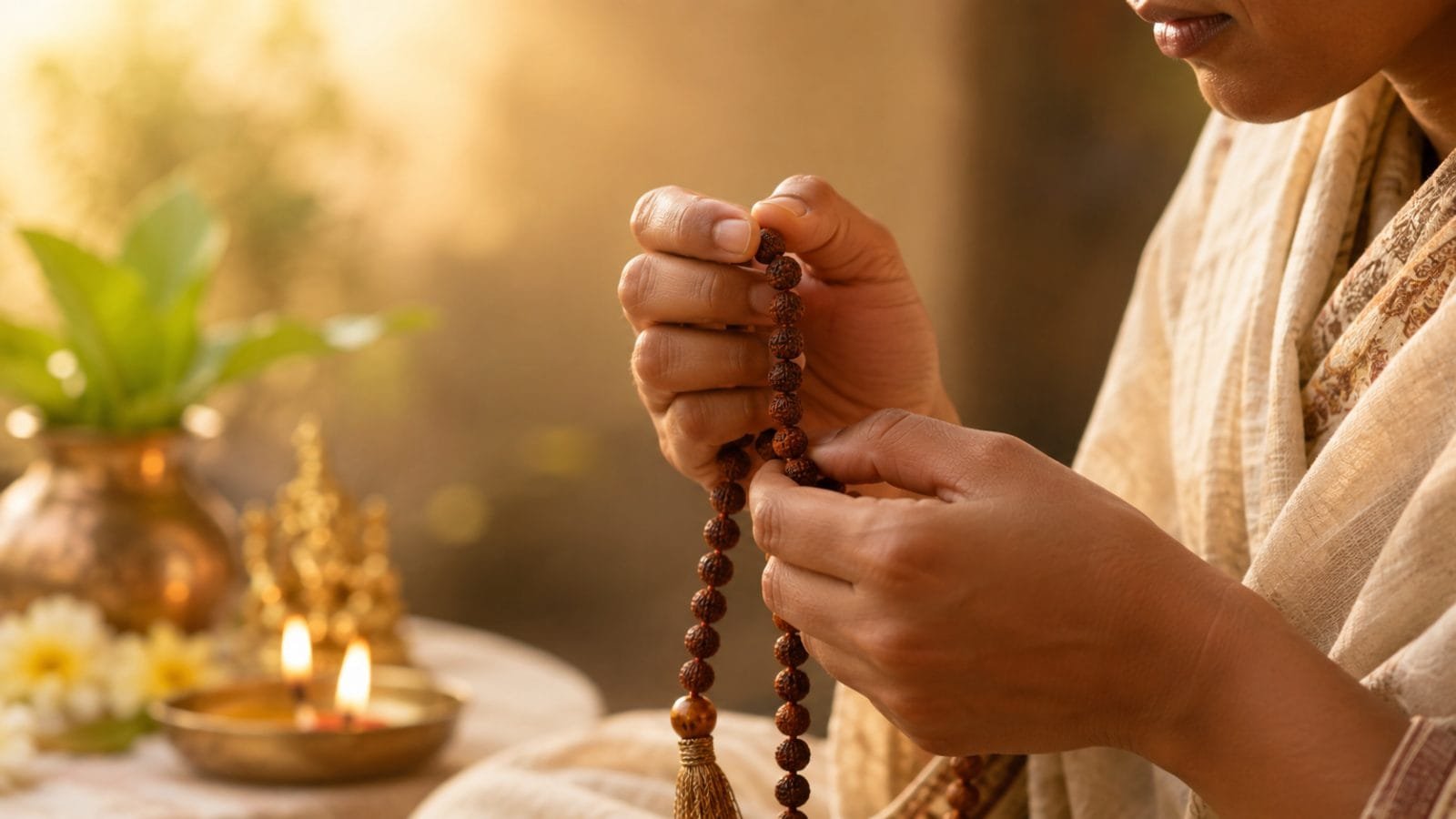
Japa mala (108 beads): the traditional solution to the attention problem. The mala externalizes the count into your hands. Each bead registers one repetition by touch; the sumeru bead (the larger bead you do not cross) tells you when one round is complete. Your mind can fully release number-tracking to your fingers. This is why the mala has been the standard japa counting tool across traditions for centuries – it is specifically designed to make counting effortless so the mind is freed for the Name.
Tally counters and clickers: one press per repetition, no display to watch. These work similarly to the mala – they externalize counting into a simple physical action. The absence of a screen is a genuine benefit during seated practice.
Smartphone apps: the trade-off here is the screen and the associated pull of notifications. A well-designed japa counter app minimizes this – large tap target, no animations mid-session, no badges demanding attention. The genuine advantage apps offer over physical tools is running totals across days: your 108 today adds to yesterday’s 108, and the day before’s. This is invisible to a mala or a clicker, and it matters for long sankalp commitments where honest accounting across weeks or months is the point. Devta App’s counter stores counts to your account, so they persist across phone changes and reinstalls. The mantra counting itself is still one tap per repetition – the screen exists, but the interaction is as minimal as a bead.
The Attention Split That Breaks Practice
The worst thing that can happen during mantra counting is for the number to take over from the Name. This is a recognizable experience: you find yourself chanting “Om Namah Shivaya, Om Namah Shivaya…” while a parallel voice in your head says “…47, 48, 49…” The number voice begins to crowd out the mantra voice. By count 80 you are mostly counting.
This happens when counting requires active attention. The solution is not to stop counting but to choose a counting method that runs on autopilot – one that lets you register each repetition without thinking about the register. The mala bead moved by your thumb; the single tap on a simple counter screen; the click of a tally. These are motor actions that become reflexive quickly and stop competing with the Name after a few sessions of practice.
The method that consistently fails is trying to count in your head while also chanting in your head. Mental counting and mental chanting use the same resource. Externalize one of them – almost always the count – and the other is freed.
What Losing Count Actually Means
Almost every person who chants regularly has had the experience of suddenly realizing they do not know what count they are on. This usually happens when the mind was absorbed in the Name itself – when the repetition became genuinely rhythmic and effortless and the “counting” part of the mind stepped back. Teachers across traditions, from the Bhakti lineages to the Sivananda tradition, agree: losing count during japa is typically a sign of absorption, not failure. The Name was doing its work.
When you lose count, the traditional guidance is simple: continue from where you estimate you are, or return to 1 and start the round again if you prefer. What you do not do is stop – stopping interrupts the absorption that caused you to lose count in the first place. A japa counter app or a mala makes re-entry easy; a mental count requires reconstructing your position from scratch.
Building a Counting Practice That Scales
For someone starting a mantra counting practice, the sequence that tends to work is:
- Start with one mala (108) daily. This is the traditional entry point. Use a physical mala if you have one, a 108 counter app if you do not. The goal is daily repetition, not large numbers.
- Track running totals from day one. Even if you only do 108 per day, knowing that you have done 3,240 in the past month changes how you relate to the practice. A japa counter that saves across sessions makes this effortless.
- Set a named sankalp when you are ready. “I will chant 1 lakh repetitions of Om Namah Shivaya this Sawan” is a different kind of commitment than “I will try to chant daily.” A named, counted goal shifts the practice from intention to accountability.
- Let the count fade as the practice deepens. After months of regular practice, many practitioners find that the Name begins to arise spontaneously – while walking, before sleeping, during routine tasks. At this point the formal counting session remains, but the Name is no longer confined to it. This is ajapa japa: the mantra that runs itself.
The counter is a training wheel for attention. You use it precisely so that one day you need it less. But there is no shame in using training wheels indefinitely – many serious practitioners count every repetition for decades, finding that the structure keeps the practice clean and honest. Use what works. The Name is what matters.
For a deeper look at counting tools and choosing the right one for your practice, see our guide on japa counter apps and digital mala counters.

Should I count mantras or just chant without counting?
Traditional teachers recommend both at different stages. Beginners benefit from a count target (108, 1 mala) because it creates a boundary that holds the practice. With time, the mantra begins to run continuously without effort (ajapa japa) and counting becomes less central. Start with counting; let the counting fade as the Name deepens.
How do I count mantras without breaking my focus?
The key is automating the count. A mala in hand, a tally clicker, or a one-tap app counter all let you register each repetition with minimal attention. The worst methods are counting on fingers mentally or watching a timer – both compete directly with the Name for your attention.
Is it bad if I lose count while chanting?
No. Losing count usually means you were absorbed in the Name, which is the goal. If you lose count, simply continue from where you think you were, or restart from 1. Tradition consistently says the Name’s benefit does not depend on an exact final number.
Related Reading