Krishna Janmashtami 2026: Date, Midnight Puja and What to Chant
A child born at midnight. A prison. Guards asleep, chains falling away, doors swinging open on their own. A river in flood – parting just enough for a father to cross, carrying an infant on his head through the storm.
This is not mythology dressed up as a story. For hundreds of millions of Hindus, this is the night that changed everything – the birth of Krishna, the eighth avatar of Vishnu, in the city of Mathura, on the eighth lunar day of the dark fortnight of the month of Bhadrapada. Every year, on Janmashtami, that midnight is relived. Not remembered. Relived.
In 2026, Janmashtami falls on Friday, 4 September. This guide explains everything you need to know – the date, the tithi system behind it, the all-important 45-minute midnight window, which mantras to chant, and how to track your jap through the night.
Krishna Janmashtami 2026: The Date and the Tithi Explained
If you have ever searched janmashtami kab hai 2026 and ended up more confused than before, you are not alone. The Hindu calendar does not run on the Gregorian solar year. It runs on tithis – lunar days – and each tithi can fall across parts of two calendar dates, or repeat, or shrink to just a few hours. This is why festivals can seem to “move” every year.
Here is what the tithi system actually means for Janmashtami 2026:
- Ashtami tithi begins: 2:25 AM on Friday, 4 September 2026
- Ashtami tithi ends: 12:13 AM on Saturday, 5 September 2026
- Janmashtami: Friday, 4 September 2026
Ashtami means the eighth lunar day. Krishna is said to have been born on the Ashtami of the dark half (Krishna Paksha) of Bhadrapada month – specifically at midnight. So the festival follows the tithi, not the date on the wall calendar. Since the Ashtami tithi runs through most of Friday and the midnight window falls squarely within Friday night, 4 September is the clear and undisputed date.
One thing worth noting this year: there is no split between traditions. Both the Smarta tradition (which generally follows the sunrise rule) and the Vaishnava/ISKCON tradition observe Janmashtami on the same date – Friday, 4 September 2026. In some years these can fall on different dates depending on how the tithi intersects with midnight and sunrise, but 2026 is a year of agreement. One date, all traditions.
Dahi Handi, the celebration associated with Krishna’s love of butter – where young men form human pyramids to break a pot of curd hung high in the air – follows the next day: Saturday, 5 September 2026.
If you want the full Hindi guide to this date with detailed regional context, it is available at devta.app/blog/janmashtami-2026-kab-hai-tithi-nishita-muhurat-jap/.
Nishita Kaal – The 45-Minute Window That Matters Most
Among all the hours of Janmashtami, one 45-minute window carries the most weight. It is called the Nishita Kaal – the deep-midnight period – and it corresponds, according to the Hindu astronomical system, to the exact muhurta (auspicious period) when Krishna was born.
In 2026, the Nishita Kaal for krishna janmashtami puja is:
- Start: 11:57 PM, Friday 4 September
- End: 12:43 AM, Saturday 5 September
- Duration: 45 minutes
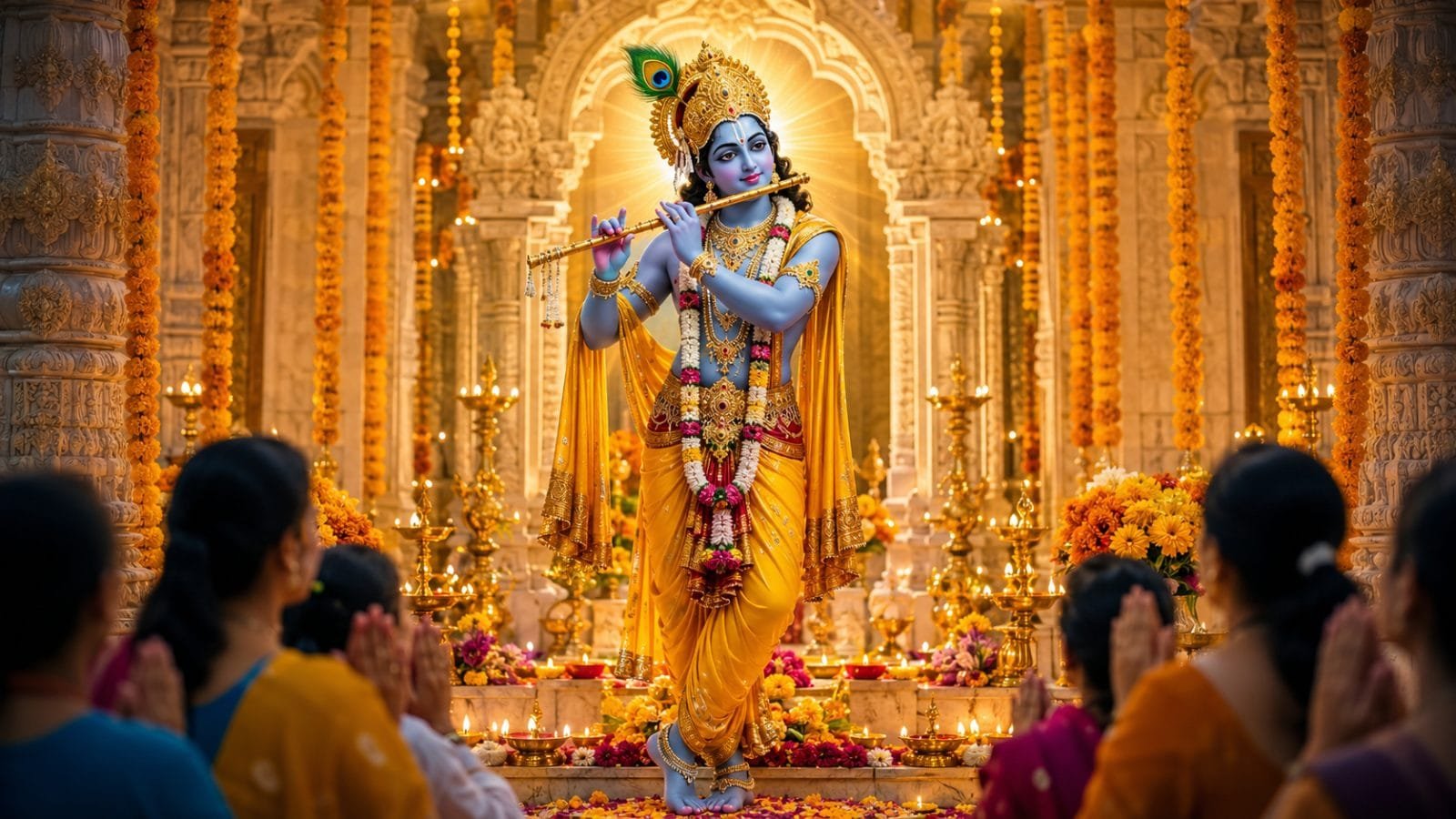
This is when the puja is performed, when the idol of Laddoo Gopal (infant Krishna) is bathed and adorned, and when the chanting is most intensely focused. Families who stay up for Janmashtami jagran (the all-night vigil) often build the entire night around this window.
What does the puja itself involve? There is no single fixed ritual – it varies considerably across regions and communities. But the common elements of a home krishna janmashtami puja during Nishita Kaal include:
- Bathing the idol of infant Krishna (Abhishek) with panchamrit – a mixture of milk, curd, honey, ghee and sugar
- Adorning the idol with fresh clothes, jewellery and a peacock feather
- Lighting a lamp (diya) and incense
- Offering tulsi leaves – said to be especially dear to Krishna
- Offering panchamrit and fruit as prasad
- Chanting mantras – either continuously from the evening, or concentrated in this 45-minute window
If you are observing a vrat (fast) through the day, the fast is broken after the puja – typically after midnight, once the birth has been commemorated. Many families do this around 12:30 AM to 1:00 AM on 5 September.
The simplest way to mark the Nishita Kaal if you cannot do an elaborate puja: sit quietly, light a diya, and chant. That alone is a complete observance.
Janmashtami Mantras – What to Chant and When
There is no single official janmashtami mantra. Different traditions recommend different chants. But there are a few that appear consistently across texts and practice, and understanding each one helps you choose what fits your own observance.
The Hare Krishna Maha-mantra
This is the most widely recommended janmashtami puja mantra for the current age:
Hare Krishna Hare Krishna Krishna Krishna Hare Hare
Hare Rama Hare Rama Rama Rama Hare Hare
Sixteen names, two lines. Its earliest textual source is the Kali-Santarana Upanishad, a Vaishnava text that prescribes it specifically for Kali Yuga – the age we are in. The text states it removes the darkness of the current age. What makes it practical for most people: there are no rules attached to it. No purity requirement. No time restriction. No specific posture. You can chant it while sitting, walking, cooking, or lying down.
For a full guide to the maha-mantra – its meaning, how to chant it in rounds, and its significance in devotional practice – see: devta.app/blog/hare-krishna-mahamantra-jaap-vidhi-kali-yug/.
Om Namah Krishnaya
Six syllables, easy to sustain through a long vigil. The meaning is direct – “I bow to Krishna.” It is drawn from the Vishnu Sahasranama tradition and works well for people who find the maha-mantra too long to sustain in mental (manasik) jap for extended periods.
Short names as jap
There is a deeper principle here, stated in the Bhagavad Gita (10.25): Krishna himself says, “Among sacrifices, I am japa-yajna.” The simplest yajna – no fire, no rules, no ritual materials required. Just the name. This means even the most informal chanting of “Krishna,” “Govinda,” “Gopala,” or “Hari” on Janmashtami is not a lesser form of worship – it is, by Krishna’s own claim, the sacrifice he identifies with most directly.
A practical approach for the night: use the maha-mantra for your formal seated rounds during the Nishita Kaal, and use shorter names like Govinda or Krishna throughout the rest of the vigil when your attention needs to stay looser.
For a detailed guide to chanting Krishna’s name with method, sequence and mala instructions: devta.app/blog/krishna-naam-jap-vidhi-mantra-mala/.
Keeping Count Through the Night – The Practical Question
Janmashtami jagran is long – from dusk on 4 September through the midnight puja and beyond. Sustaining a chanting practice through several hours raises a practical question that every devotee eventually faces: how do you keep count?
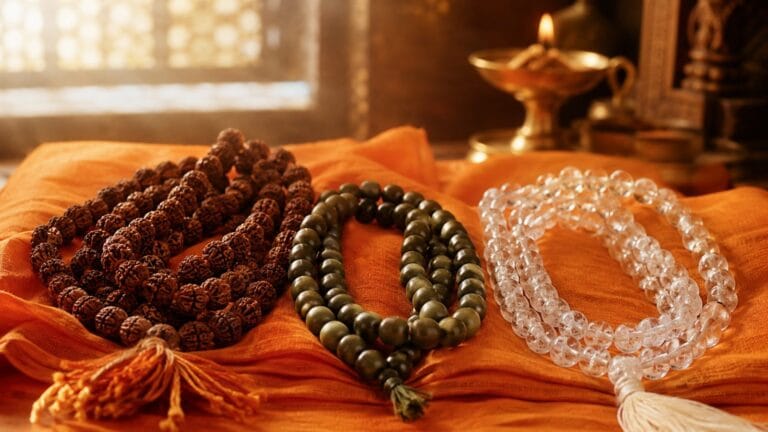
The traditional answer is a jap mala – a string of 108 beads. One bead per repetition, one full round = 108 chants. The sumeru bead (the larger bead at the end) marks the boundary; you do not cross it, you reverse direction. For the maha-mantra, ISKCON devotees typically aim for 16 rounds per day – 1,728 repetitions.
On a festival night, when you are also handling puja materials, keeping the diya lit, offering items, and possibly looking after children or elderly family members, a physical mala can be difficult to manage. You set it down for a moment and lose count. Or you drop it during the abhishek.
This is where a digital counter becomes genuinely useful – not as a replacement for traditional practice, but as a hands-free backup. The Krishna jap counter in the Devta App is designed for exactly this kind of session: tap once per maha-mantra repetition, the app counts your rounds, and your total syncs to your account so it is never lost if your phone runs out of battery mid-night. You can also share a session with family – useful when you are chanting together as a household but everyone needs their own count.
The Devta App is free, no ads, 4.8 stars, with 20,000+ installs. It works for any mantra, not just the maha-mantra – so whether you are counting Om Namah Krishnaya or a shorter name, it handles it the same way.
For a broader overview of how digital jap counters work and how to use them alongside a mala, see: devta.app/blog/japa-counter-app-digital-mala-account-synced/.
After Janmashtami – Dahi Handi and What Follows
The day after the midnight puja – Saturday, 5 September 2026 – is Dahi Handi. The festival celebrates a famous episode from Krishna’s childhood: his habit of sneaking into neighbors’ homes to steal butter and curd, which he would share with his friends. In Maharashtra especially, Dahi Handi is celebrated at a large public scale – teams of young men (Govindas) form multi-tier human pyramids to reach and break a pot of curd (handi) hung at height, sometimes 20-30 feet above the ground. Cash prizes are awarded. It is competitive, physically demanding, and genuinely spectacular.
For most families observing at home, 5 September is the day for breaking the fast properly, distributing prasad to neighbors, and resting. The intensity is in the night of the 4th.
One more thing worth doing after Janmashtami: if you set a jap sankalp (a commitment to chant a certain number of repetitions) for the festival, keep it going. A single night of intense chanting opens a door – the tradition of naam jap is built on what you do in the ordinary days after the festival, not just the extraordinary ones. The 45-minute Nishita Kaal is the ignition. What follows is the journey.
When is Krishna Janmashtami 2026?
Friday 4 September 2026. Ashtami tithi begins at 2:25 AM on 4 Sep and ends at 12:13 AM on 5 Sep. Nishita puja, the auspicious midnight window, is 11:57 PM to 12:43 AM (45 minutes).
Is Janmashtami on the same date for all traditions in 2026?
Yes – in 2026 both Smarta and Vaishnava/ISKCON traditions observe Janmashtami on the same date, 4 September. There is no split this year.
What is the best mantra to chant on Janmashtami?
The Hare Krishna Maha-mantra (from the Kali-Santarana Upanishad) is traditionally recommended for Kali Yuga – 16 names, no rules, no purity requirement. Shorter names like Om Namah Krishnaya or Govinda are also powerful. The key is consistency through the night.