He Wrote It in a Prison Cell – and Walked Free. The Untold Story of the Hanuman Chalisa
Forty verses. Around four minutes to recite. Memorised by hundreds of millions of people who have never met. The Hanuman Chalisa is the most-recited devotional poem on earth – yet most people who chant it daily have never heard the astonishing story of how it came to be written. According to tradition, it was composed not in a temple or an ashram, but inside a prison cell. And what happened next is why people trust it to break their own troubles.
The prison-cell legend
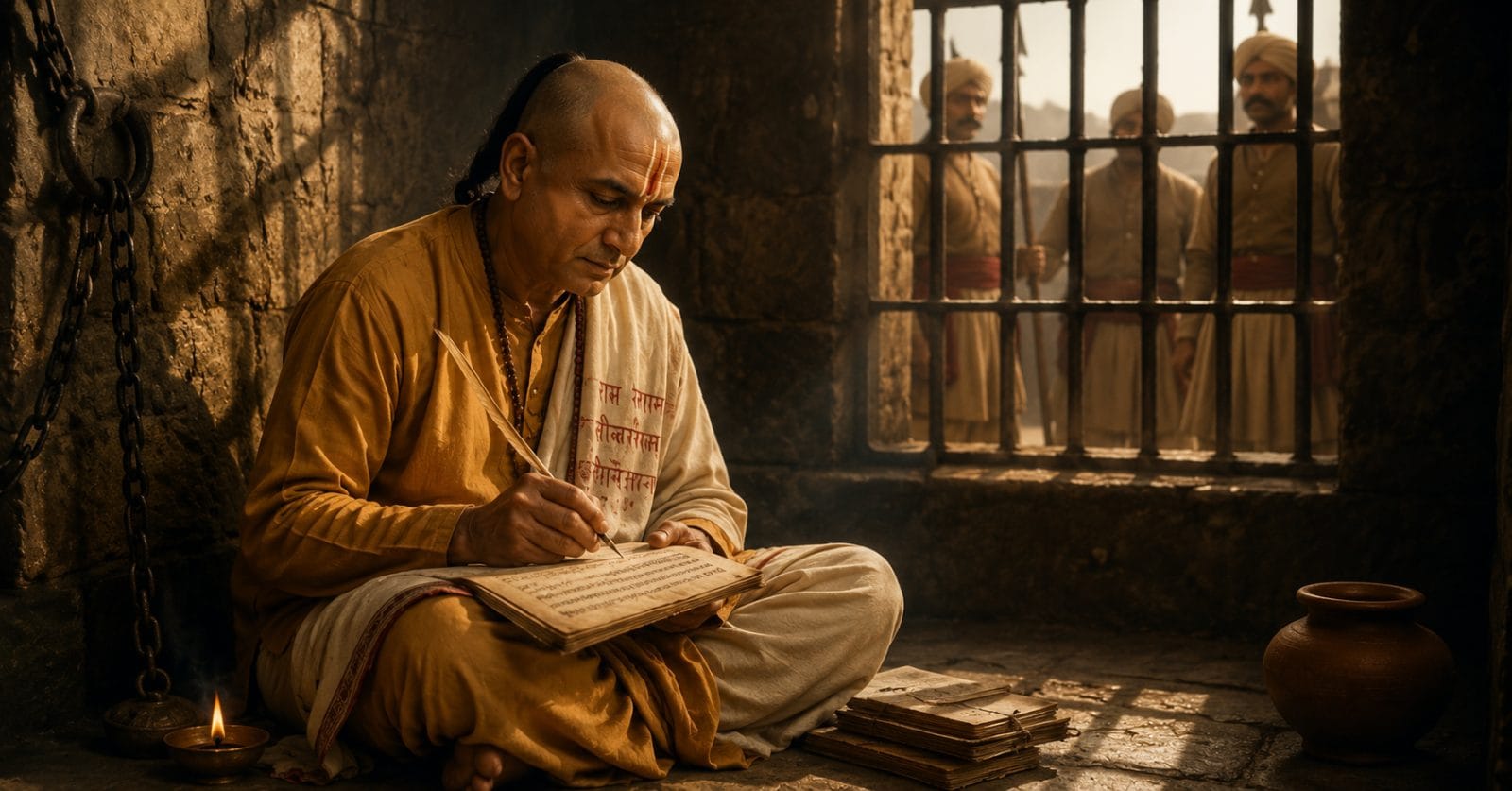
The Chalisa is attributed to the great saint-poet Goswami Tulsidas (1532-1623), who also gave us the Ramcharitmanas. As the popular tradition goes, Tulsidas was once wrongly imprisoned. Locked away and helpless, he turned to the one he trusted most – and poured his devotion into forty verses praising Hanuman.
The story says that as the verses were recited, an army of monkeys descended upon the city, causing such chaos that the ruler had no choice but to release the saint. Whether you read it as miracle or metaphor, the meaning devotees take from it is the same: the Chalisa was born as a prayer that breaks chains – which is exactly why people reach for it when life locks them in.
It also explains the trust placed in one of its most-loved lines:
संकट ते हनुमान छुड़ावै
Sankat te Hanuman chhudaave
“Hanuman frees you from every crisis.”
Why exactly 40 verses?
The name itself is the clue. Chalisa comes from chालीस (chalis) = forty – the poem’s forty chaupais (quatrains). These are framed by two opening dohas (couplets) that ask for blessings, and one closing doha. So the full structure is: 2 + 40 + 1. Nothing about it is accidental – it was built to be recited in one steady, unbroken flow.
The verses everyone chants – and what they actually mean
You can recite all forty without knowing the meaning, and many do. But the Chalisa hits differently once you know what you’re actually saying. A few of the most powerful lines:
- भूत पिशाच निकट नहिं आवै, महाबीर जब नाम सुनावै – “No evil or negativity can come near the one who calls Hanuman’s name.” This is the verse people recite for protection and fear.
- नासै रोग हरै सब पीरा, जपत निरंतर हनुमत बीरा – “Constant remembrance of Hanuman destroys disease and removes all pain.”
- जय जय जय हनुमान गोसाईं, कृपा करहु गुरुदेव की नाईं – asking Hanuman to bless the devotee as a guru blesses a disciple.
The verse that may have measured the distance to the Sun
Here’s the part that stops people in their tracks. One verse describes how the child Hanuman, mistaking the Sun for a ripe fruit, leapt toward it:
जुग सहस्र जोजन पर भानु, लील्यो ताहि मधुर फल जानू
Jug sahasra jojan par Bhanu, leelyo taahi madhur phal jaanu
Read literally, it states the Sun (Bhanu) is “yug × sahasra × yojan” away. Using the traditional values – 1 yug = 12,000, 1 sahasra = 1,000, 1 yojan ≈ 8 miles – the multiplication lands remarkably close to the actual average distance from the Earth to the Sun. Coincidence or encoded knowledge, it’s a line that has fascinated devotees and scientists alike. (Treat it as wonder, not peer-reviewed astronomy – but it’s a beautiful thing to notice as you chant.)
When and how to recite it
- Best days: any day, but especially Tuesday and Saturday – here’s the story behind why those two days belong to Hanuman.
- How many times: once daily is a beautiful habit. On Tuesdays/Saturdays, many recite it 7 or 11 times.
- How to sit: face east or toward an image of Hanuman, light a diya, and recite slowly enough to feel each line.
Watch: the Hanuman Chalisa in full
View this reel on Instagram
Never lose count again
The hardest part of a daily Chalisa habit isn’t the four minutes – it’s remembering to do it, every day, and keeping count. The free Devta App gives you a live Hanuman Chalisa jaap counter, daily darshan, and a devotion streak that gently keeps you going. 👉 Start your free daily Chalisa habit on the Devta App.

Frequently asked questions
Who wrote the Hanuman Chalisa?
The Hanuman Chalisa is traditionally attributed to the 16th-century saint-poet Goswami Tulsidas, who also composed the Ramcharitmanas. Popular tradition says he composed it while imprisoned.
Why is it called Chalisa?
Chalisa comes from chalis, meaning forty in Hindi. The poem has forty chaupais (verses), framed by two opening dohas and one closing doha.
What is the best time to recite the Hanuman Chalisa?
Any time is good, but early morning is ideal, and Tuesdays and Saturdays carry special significance for Hanuman worship. Many devotees recite it once daily, or 7 or 11 times on Tuesdays and Saturdays.
What are the benefits of reciting the Hanuman Chalisa?
Devotees recite it for courage, protection from fear and negativity, relief from troubles, and peace of mind. Its value lies in sincere, consistent devotion rather than a fixed count.
Related Reading