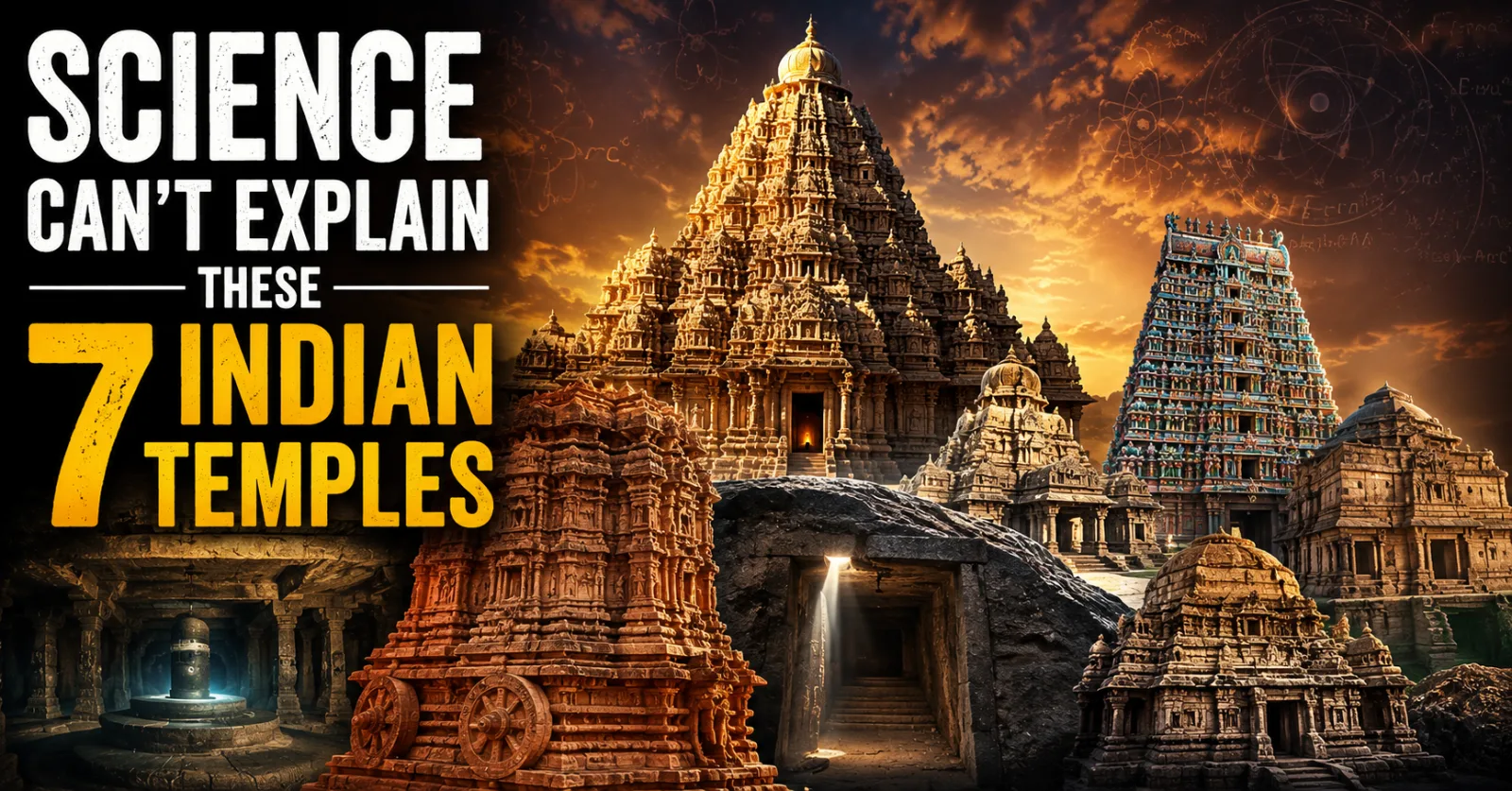
Science Can’t Explain These 7 Indian Temples. Believers Say They Don’t Need To.
India’s temples weren’t just places of worship – they were the supercomputers, observatories and art studios of their age, built by people who somehow achieved things we still can’t fully reverse-engineer. Some of what they left behind has a clean scientific explanation. Some of it, even today, makes engineers go quiet. Here are seven temples whose mysteries still spark debate – and why believers say they never needed the explanation in the first place.
1. Brihadeeswarar Temple, Thanjavur – the tower that casts no shadow
Built by Raja Raja Chola I a thousand years ago (c. 1010 CE), this temple’s vimana rises about 66 metres – and it’s crowned by a single capstone said to weigh around 80 tonnes. The question that has never been fully settled: how did anyone lift that much stone that high, without cranes? The popular answer – a 6 km earthen ramp – is plausible but unproven. And visitors will tell you something stranger still: it’s widely claimed that the great tower’s shadow never falls on the ground around noon, seeming to disappear into the structure itself.
2. Kailasa Temple, Ellora – carved from the top down, out of one rock
Most buildings go up. This one went down. The Kailasa Temple was carved out of a single basalt hill – from the top downward – removing an estimated 200,000 tonnes of rock with no margin for error, because you cannot “undo” a chisel stroke in solid stone. There are no joints, no bricks, no assembly: it is one continuous sculpture the size of a multi-storey building. Done in the 8th century. The level of planning required still astonishes modern architects.
3. Lepakshi Temple – the pillar that hangs in the air
At the Veerabhadra Temple in Lepakshi, Andhra Pradesh, one of the seventy stone pillars doesn’t quite touch the ground. Visitors slide sheets of cloth and paper clean underneath it – a ritual believed to bring prosperity. It’s thought to be a deliberate feat of balance and engineering by 16th-century Vijayanagara builders, but exactly how it stays so perfectly poised remains a favourite puzzle.
4. Jagannath Temple, Puri – where the flag defies the wind
Puri’s great temple comes with a list of phenomena that visitors and priests have described for centuries:
- The flag atop the temple is said to flutter against the direction of the wind.
- A priest climbs the roughly 65-metre tower by hand every single day to change that flag – a ritual unbroken for centuries, and one belief holds the temple would have to close if it’s ever missed.
- The main dome is said to cast no visible shadow at any time of day.
- Unlike most coastal spots, birds are said not to fly over the temple, and the sea breeze behaves in reverse near it.
5. Konark Sun Temple – a clock made of stone
Shaped like the sun god’s colossal chariot, the 13th-century Konark temple has 24 intricately carved wheels – and they aren’t just decoration. Several function as accurate sundials, their spokes and rims marking time down to the minute by the shadow they cast. Legend also speaks of a massive lodestone once mounted at the top, powerful enough to make the main idol float in mid-air and to throw the compasses of passing ships into chaos – said to be why it was eventually removed.
6. Vittala Temple, Hampi – pillars that sing
Tap the slender stone pillars of Hampi’s Vittala Temple and they ring out with musical notes – the famous “SaReGaMa” pillars, carved so precisely that they resonate like instruments. The British are said to have cut two of them open to find the source of the sound; they found nothing inside but solid stone. How 15th-century artisans tuned rock remains beautifully unexplained.
7. Stambheshwar Mahadev, Gujarat – the temple the sea swallows daily
On the coast at Kavi Kamboi, this Shiva temple vanishes completely beneath the sea at high tide – and re-emerges, dripping, when the water pulls back. Devotees time their darshan to the tide charts. There’s a clean tidal explanation, of course – but watching an entire temple disappear and return twice a day feels like anything but ordinary physics.
So – mystery, or genius?
Here’s the honest truth: several of these have rational explanations – clever engineering, tidal cycles, careful astronomy. But that may be the real wonder. People a thousand years ago, without machines or modern math, encoded sunclocks into stone, balanced pillars on air, and tuned rock to sing. Whether you call it science or devotion, it came from the same place: an extraordinary care for getting something exactly right, in the name of God.
Watch: India’s temple wonders
View this reel on Instagram
Visit a temple every morning – wherever you are
You can’t travel to all seven – but you can begin every day with darshan. The free Devta App brings daily darshan of your favourite deities to your phone, with a jaap counter and a devotion streak to keep you going. 👉 Download the Devta App and start free.

Frequently asked questions
Which is the most mysterious temple in India?
Many consider the Jagannath Temple in Puri the most mysterious, due to its flag that flutters against the wind, its shadowless main dome, and the daily ritual of changing the flag by hand atop the 65-metre tower. The Kailasa Temple at Ellora and Hampi’s musical pillars are other top contenders.
Are the mysteries of these temples scientifically proven?
Some have clear scientific explanations, such as the tidal cycle at Stambheshwar Mahadev and the sundial wheels at Konark. Others, like how the Lepakshi hanging pillar stays balanced or how Hampi’s pillars produce musical notes, are admired feats of ancient engineering that are still studied and debated.
How was the Kailasa Temple at Ellora built?
The Kailasa Temple was carved from a single basalt rock from the top downward in the 8th century, removing an estimated 200,000 tonnes of stone. It is a single continuous sculpture with no joints or assembled blocks, which is why its construction still amazes architects.
Why does the temple at Stambheshwar Mahadev disappear?
Stambheshwar Mahadev sits on the Gujarat coast and is submerged by the sea at high tide, reappearing at low tide. Devotees plan their darshan around the daily tide timings.
Related Reading